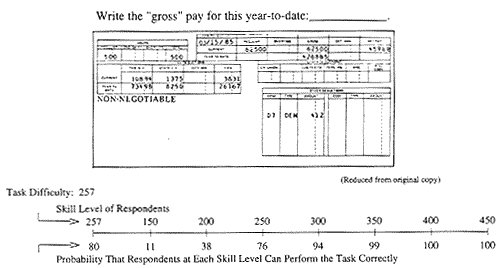
| FIGURE 75 |
Document Literacy * |
| Source: I. Kirsch and A Jungeblut.
(1986a) Literacy: Profiles of America's Young Adults. Princeton, NJ:
Educational Testing Service, National Assessment of Educational Progress.
(p.23) |
* This item was also used in the 1992 National
Adult Literacy Survey (NALS).
In the Document literacy assessment, 73 percent
of the tasks demanded 300 level skills or lower, while 57.2 percent of
young adults possessed 300 level skills or higher. Thus, the Document
tasks tended to be skewed toward the easy end of literacy task difficulties.
Overall, the average percent correct for Document literacy tasks was 83.3
(Table 4.1, page IVY of the source cited on page 99). Whites scored 85.9,
Hispanics 77.6, and Blacks 71.8 percent correct on the average for Document
tasks. While 65.4 percent of Whites scored at the 300 skill level or higher,
only 37.0 percent of Hispanics and 19.8 percent of Blacks scored at the 300
skill level or higher (see Figure 4.2, page IV-18 of the source document cited
on page 99). Note that, if one focuses on the fact that only one in five Blacks
were at the 300 skill level or above on the Document scale, one might infer a
very low performance level for Blacks on Document tasks. Yet, overall, Blacks
performed over 70 percent of the Document tasks correctly. This apparent
contradiction results from the fact that to be at the 300 level of skill
requires that people possess an 80% probability of being able to perform tasks
that are at that level of difficulty. But people with lower levels of skill
have a greater than zero probability of being able to correctly perform 300
level tasks. When the latter are taken into consideration, as in calculating
the overall average percent correct, then a much greater percentage of the
population may be seen to be able to perform Document tasks across the full
range of difficulty levels, from easy to hard, than are able to perform tasks
at the 300 level of difficulty or above.
|