|
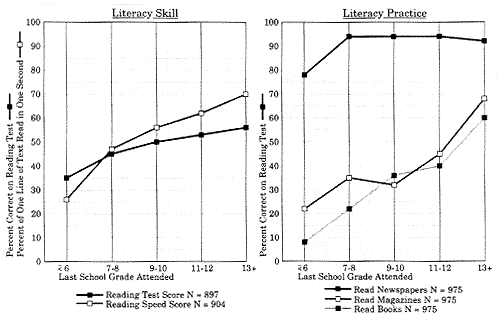
Buswell's Study of Adult Literacy In Chicago - 1937 In 1937 Guy Buswell, of the University of Chicago, published the results of studies of reading conducted with some one thousand adults having various years of education who lived in the Chicago area. He developed a battery of tests that measured skills in reading functional materials such as food ads, telephone directories, and movie ads, as well as more traditional "academic" tests of paragraph comprehension and vocabulary knowledge. As another indicator of reading skill, Buswell obtained eye movement data for most of the adults. These data made it possible to see how reading skill changed as a function of education when measured in terms of the percent of one line of text that could be read in one second. In addition to measures of reading skill, Buswell also obtained data on reading practices of the adults. In interviews with the adults, regarding newspaper and magazine reading, the question was asked: "Do you read newspapers and magazines regularly, only occasionally, or not at all?" In regard to books, the question was stated: "Do you read many books, few books, or none?" Figure 15 summarizes the results obtained by Buswell for both reading skills and practices. As indicated, both skills and practices increase as years of education increase. This suggests that one function of education is to guide readers to read more and that reading more leads to greater skill. In turn, this may lead one to be more successful in school and to pursue further education, thus leading to greater reading practices and greater skill and so forth. The reading test items that Buswell used are given in Figures 16 - 21.
|
||||||||||||||||