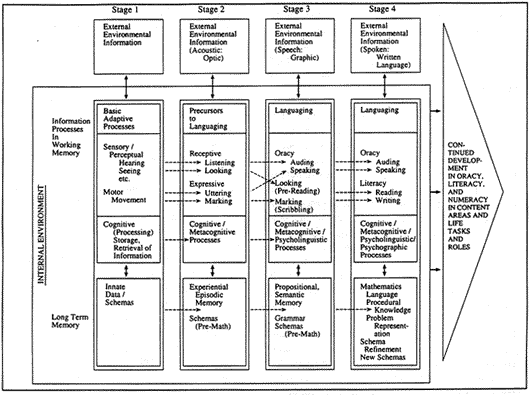
At the top of Figure 2, there are references to four "stages." In the present case, the concept of "stage 1" does not refer to automatic and immutable cognitive "unfoldings." Rather, the term refers to what would typically be observed at different times if one studies children growing up in our literate society. For instance, stage 1 refers to the newborn infant who is considered to be innately endowed with the Basic Adaptive Processes involved in sensory/perceptual processes such as hearing and seeing, etc., motor movement, and cognition, including the processes needed to acquire information, mentally manipulate it, store it in memory, form knowledge structures out of it, retrieve and represent the information in various ways. In stage 1, these processes are assumed to work more or less automatically without conscious control, hence an observer would note that the infant seems "captured" by stimuli, rather than selective in observing information in the world. Stage 2 represents the emergence of conscious control over information pick-up and manipulation. This active process of attending to information distinguishes listening from hearing, and looking from seeing, as information pick-up processes. Listening and looking build internal representations that may be called images. Images may also be constructed from data stored in long term memory. These internal imaging processes are frequently assessed in aptitude tests as "spatial perception" or "mechanical comprehension" in which it is necessary to mentally visualize and rotate cog-and-gear assembles to determine what effects this movement might have on some other gear. |
|||||||