|
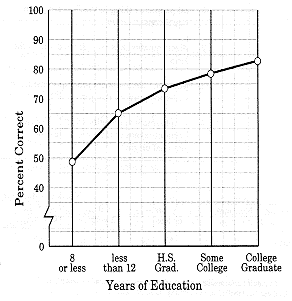
The Adult Performance Level Study The Adult Performance Level (APL) study began in 1971 as a project funded by the U. S. Office of Education. It introduced the concept of "competency- based" education to the field of adult basic education. The term "competency-based" meant that adult basic education was to be focussed on achieving measurable outcomes. By 1977, when the project was completed, two-thirds of the states had implemented some form of "competency-based" adult basic education. An overview and critique of the APL project is presented by Fischer, Haney and David (1980). Test items that were included in the final (unpublished) report of the APL project are reproduced on pages 68 through 97. Each item shows what the examiner said and what the respondent did. For instance, in Figure 38, Item 1, the examiner gave the respondent a card with a sign on it about the ABC Company. The examiner says, orally, "Here's a notice that's on a company bulletin board. Please read the notice to me." The respondent then reads the sign out loud. This procedure is followed on each item. That is, the instructions are given orally, and the respondent looks at and reads some information display and makes a response. For each item, information is given showing the national average percent getting the item correct, and then the average percent correct obtained by adults with different years of education. Figure 37, below, presents the average percent correct scores over all items for adults at the different levels of education. Reference Joan Fischer, Walt Haney, & Lloyd David (September, 1980). APL Revisited: Its Uses and Adaptation in States. Washington, DC: National Institute of Education, Office of Educational Research and Improvement, U. S. Department of Education.
|
|||
| Previous Page | Table of Contents | Next Page |