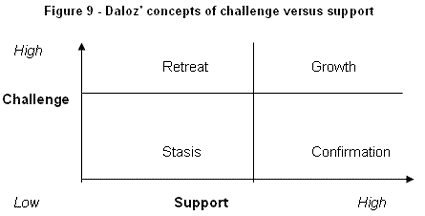
Daloz defines support as “the activity of holding, or providing, a safe space where the student can contact her need for fundamental trust, the basis of growth” (op. cit., p. 209) and challenge as “opening a distance in the relationship, drawing the student outward to fill the gap, straining him to move, to accommodate his inner structures to the new environment created by the mentor’s18 distancing” (op. cit., p. 216). He argues that support and challenge need to be kept in a careful balance in order to promote learning and personal growth. “If both support and challenge are low, little is likely to happen (‘stasis’). Things stay pretty much as they are” (op. cit., p. 208). Too much challenge in the absence of appropriate support on the other hand, can drive the insecure student into ‘retreat’. But he also argues that a high level of support without a commensurate amount of challenge (as found in some highly student-centred programmes) also amounts to little long-term impact (‘confirmation’). A delicate balancing of the two factors on the other hand, can provide substantial impact on learners (‘growth’).19
The need to extend or challenge their learners can be seen in the following excerpts from teacher interviews:
| T1: | They actually do have a need and they express that they do want to learn, they want to be able to do things so yes, working from the known, sometimes it doesn’t actually work. They do need more challenges, so I do find that for them not to be just satisfied with things that they can do, and they often say this - you know, you expect us to do a lot more than we think we should. | |
| T2: | So I read the articles, but as you noticed today I started, I always try to push them a little bit past their comfort zone, so now I’m starting to ask them to actually take bits of it and some of them can do that quite well and others panic a bit. Especially today, but yeah, so that’s the idea. |
And in the following excerpt, the teacher is being both supportive (and respectful) of the learner’s opinion about cultural differences, but also challenging him about his observations about these differences as barriers to communication in the workplace.
18 Although written originally about mentoring, Daloz’ work has been applied
widely to teaching adults generally.
19 See also Venezky et al.’s case studies (1996) of literacy students.