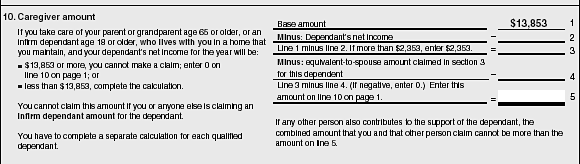
|
To see if he
or she can claim an amount on page 1, the form-filler has to ask, “Can I
claim a tax credit as a caregiver if I look after my old dad?” He or she
will have to match one of the two criteria given (parent who is over 65; infirm
dependent who is 18 and older). The type of information requested is an
attribute–can the form-filler describe him or herself as a
‘caregiver?’ (2) Type of match: locate (1); one search phrase (+0);
one item response (+0); match requires low-level inference (+1); no inference
for new information frame (+0) total rating (2). No distractors.
In section
10 on page 4, another two criteria are added to the two mentioned in the box on
the first page, that of co-residence and income. We find that the infirm
dependent or aged parent has to live with you and make less than
$13,853. The complete directive, starting with If you take care . . .
and ending with complete the calculation is about sixty words long and
contains 7 subordinate clauses (counting those that have been reduced to verbal
phrases). Thus the task is to make a match on five phrases–parent, over
65, lives with you, home you maintain, makes less than $13,853,
net.
Answering
the same question as that posed on page 1: Type of information: attribute (2)
Type of match: locate (1); four feature match (+3); one item response (+0);
match requires low-level inference (+1); no inference for new information frame
(+0) total rating 5. No distractors.
Those who
must calculate a caregiver amount, have to complete two relatively uninvolved
subtraction operations. The first uses an amount found on an external document
(assumed to be given), the second has to be searched for on the form itself.
|
|
Type
Prose |
Level
1 |
|
ToI
2 |
ToM
2 |
PoD
1 |
|
Type
Prose |
Level
2 |
|
ToO
2 |
SoO
5 |
PoD
1 |
|