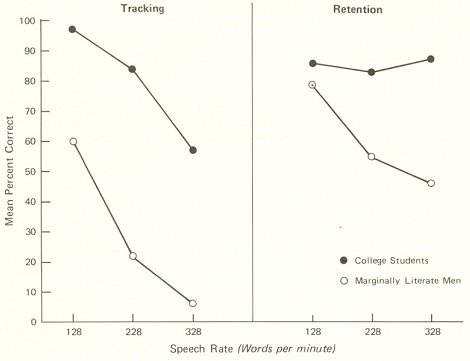
Figure 8
Tracking and retention performance at three speech rates
for college students and marginally literate men.
Results are presented in Figure 8. Notice first that college students were able to maintain high conceptualization rates (immediate retention) over the three rates of presentation of this very simple, 5th grade story. However, their tracking scores dropped significantly as rates were increased. We interpret these data according to the flow chart of Figure 9. In performing this task, students first form an internal representation of either the auding message or the reading message. Here we have assumed that the auding message is internally represented first, because it sets the pace, which is especially important at the faster rates of speech. The internal auding message is then related to the conceptual base (Sequence A) and stored in short-term memory (STM) (Sequence B). Then the print is decoded into an internal representation of the same form as a spoken word, in keeping with the developmental model, and stored in STM. There the two representations are compared. If they match, the cycle is repeated. If not, the circling or checking response is made and then the cycle is repeated.