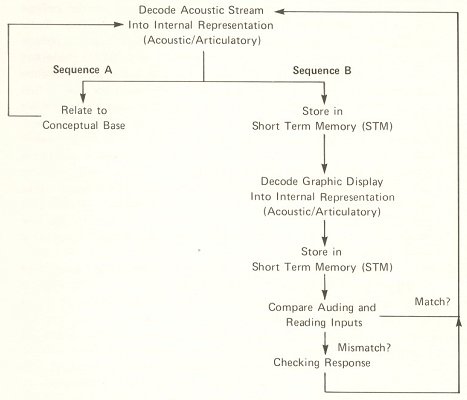
Figure 9
Flow chart of tracking and retention behavior.
So long as the slower rates of presentation are used, the college students have no trouble performing all of the foregoing processes (and probably others which we have not bothered to separate out). However, at the faster rates, the processes involved in Sequence B become too time consuming, and so the college students drop some of the decoding print-to-speech and matching processes in favor of tracking the auding message to store information in the conceptual base for use in taking the immediate retention test. We suspect they emphasize auding rather than reading because, if they ignored the auding message, they could not do the mismatch task, yet their tracking scores are not zero, so they are doing some of the Sequence B processes, and the auding message again sets the pace for these processes.