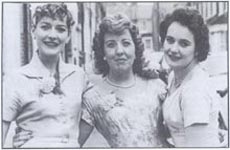
 Freda Dowie, Pete Positlethwaite, and Angela Walsh in Terence Davies' DISTANT VOICES/STILL LIVES One of the highlights of the week appears to be the Sunday morning Church service. As they giggle and chatter under cover of the priestly chanting, and pass notes under the somewhat relaxed gaze of the guards, they are well aware that they are subverting a traditional ceremony. When they respond en masse with raised fists to another prisoner being led away for some minor infraction, this idea is reinforced. For the most part these women are not particularly political; indeed, their social attitudes are rather traditional and their most enduring attachments are to their husbands and children. But they do demonstrate that they are capable of conscious mass political actions, such as when they go on a hunger strike to protest Barbara's two-year stint in solitary. When Czenki went behind bars, political prisoners had the choice of living with other politicos or staying with ordinary criminals (whom Czenki calls "social prisoners"). This opportunity is not given to political prisoners today, perhaps because of the success of Czenki's organizing efforts. Distant Voices/ Still Lives, British director Terence Davies' second film, deservedly won the International Critics Award at the 1988 Festival of Festivals. His first film, the spare and depressing Terence Davies Trilogy, took ten years to make. Its stark black-and-white footage and austere style suited its subject - gay oppression and Catholic repression in working-class England during the 1950s and '60s. Distant Voices/Still Lives is as autobiographically-based as the trilogy, but it's a much jollier film. These hard working-class lives do have their sunnier moments, although ultimately the feelings we are left with are emotional dislocation and stifled potential Structured around the death of the father, the film is basically a wake, an exploration of the love-hate relationship between the entire family and their brutal patriarch. Still Lives drifts slowly toward the wedding of the last child, an event that signals the disassembly of a once strong, though traumatized nuclear family. These siblings are now all on their own with nothing to lean on but their own strengths and the succour they find within social conventions. It is with sadness - and understanding - that one comes to realize how much of the worst aspects of their parents' lives these young people are already in the process of repeating. In the repressed British working-class milieu, the men are allowed limited outlets for emotional expression - mainly for sports, They may be patriarchs, but their place within the broader social hierarchy isn't very high: they can consistently dominate only "their" women and children. Even in this context, the father's violence seems excessive. He sends his schoolboy son away, forces one daughter into the basement with the rats, and throughout barely demonstrates a glimmer of affection. Only when he slaps two of the children for arriving late at the bomb shelter during an air raid, do we realize that, in his own way, he really does care for them. As he begrudgingly gives one of his daughters money to go dancing, we learn that this monster himself was once a "dance-mad" boy, who loved to dazzle the crowd on the dance floor. What happened, then, to turn him from a charmer to a curmudgeon? 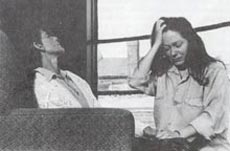 Jackie Burroughs (Mrs. Ambrose) and Emma Richier (Joanns) in Lori Spring's INSIDE/OUT |
| Back | Contents | Next |