|
FILM REVIEW Toronto Festival of Festivals 1988 by Randi Spires One of the most startling aspects of Margarethe von Trotta's first solo directorial effort, The Second Awakening of Christa Klages (1978), is its premise: to those who are unaware that the film is based on a real-life incident, the idea that someone would rob a bank to get funds for a co-operative daycare center does seem a bit far-fetched. The focus of von Trotta's work was the psycho-political development of her protagonist from the time of the armed robbery until just after her arrest. Unlike the fictional Klages, the real-life bank robber, Margit Czenki, did not take a hostage, did not run off to an idyllic Portuguese hideaway, and did not get off scot-free. Czenki, in fact, spent several years behind bars, including time in solitary confinement. It's not surprising, then, that when it came time for Margit Czenki to tell her story, she focused not on the crime but on her incarceration. The result - Accomplices - is an amazingly accomplished first film. With no hint of apology or self-justification, Czenki's cinematic alter-ego, Barbara, is portrayed as guilty as charged. The political nature of the heist is barely mentioned as Czenki delineates the cruelties of prison life. For much of the film the camera is canted so that the viewer feels the disorientation a prisoner must experience. The camera moves almost continually, but the area revealed by each shot is usually narrow, with the larger picture only occasionally established. This fragmentation of vision reinforces the sense of disorientation. The result is an edgy prisoner-eye-view of the proceedings that is at once involving and distancing. For it is difficult to identify with many of these women, some of whom committed serious crimes. Besides the bank robber and the inevitable junkie, there is a woman who murdered her child to keep the girl from enduring the misery of a children's home; without agreeing with her "solution," one can feel a certain sympathy for her. It's unlikely she's a danger to anyone else; obviously she belongs in a mental hospital - not a jail. Because few have a penchant for reading or writing, filling all those hours is a constant struggle. Solutions range from the conventional (gardening, needle-point) to the bizarre (one woman built a elaborate cockroach castle for what are normally the most unwelcome of cell-mates). The condition that these women have been reduced to is that of closely-watched but deprived children. They are forbidden intimacy (denying children affection is called emotional abuse), permitted no privacy and kept from meaningful decisions abut their lives. How penal authorities expect those incarcerated for any length of time to function upon release as emotionally mature, responsible citizens is a mystery. The women are often understandably angry or frustrated but, for the most part, they daren't lash out at their keepers. With no solutions to their problems and few ways of displacing their anger, it is almost inevitable that they occasionally erupt into childish tantrums, trashing their cells and often destroying those items they most value. Even the politicized Barbara succumbs at one point over-turning her bed, "tossing her food about and smashing the flowers she has so carefully cultivated. 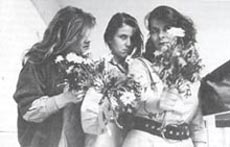 Pola Kinski, Terese Affolter, Marianne Rosenberg in Margit Czenki's ACCOMPLICES |
| Back | Contents | Next |