|
Reviews of Two Literacy Publications SPIRITS RISING: 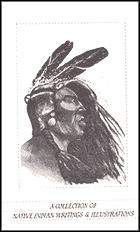
Toronto: Frontier College Press, 1987. Priscilla Hewitt Spirits Rising, a collection of writings by learners attending the Native Tutoring Center in Vancouver, is appropriately named. The colorful, glossy booklet is indeed a showcase for the powerful stories by Natives who were told they could not write. My own spirits started to rise as I read, with pride, the fifteen selections of poetry, prose and short stories. The writers have captured the essence of topics which impact on the lives of our people- relationships, memories of the reserve, handling new situations and preserving our culture. I could visualize clearly the animals and the birds that Russell describes seeing during his first visit back home in about twenty-five years. When Leonard writes about adopting his nephew, Matthew, and the poignant changes in both of their lives, I am reminded of how our extended family system is very much in place even today. Linda's poem talks about different types of hugs and their meaning. In some of our traditional ceremonies, hugs are used as a type of greeting, a way of showing that we come to the ceremony with an open heart and an open mind. The piece of prose submitted by Erica accurately reflects the sense of loss we feel when we see the beauty of Mother Earth marred by landmarks of the Industrial Revolution — factories. Each of the writings is illustrated by either Michael Whiteloon, an Ojibway artist from Manitoulin Island in Ontario, or Duane Howard of the Mowachacht Band on Vancouver Island. Both Michael and Duane have incorporated strong overtones of spirituality into their illustrations — the eagle represents strength our culture and the two sides of a feather teach us that we must strive for balance in our lives, the circle means we stand beside each other as equals and that we all have something significant to contribute. We are treated to the viewpoints of people from different areas of life - male, female, single, with family possibilities, youth and those who experienced a few more years. The most powerful aspect of Spirits Rising is the fact that these pieces of writing were submitted by PEOPLE WHO WERE TOLD THAT COULD NOT WRITE. Somewhere along the line, their spirits rose as came to believe in themselves, to feel they had something worthy to preserve writing and to share with others. Thanks to the Native Tutoring Center in Vancouver for showing us what can be accomplished when we take the time share with others. Thanks to Frontier College for forming the partnership with the Native Education Center that result - in the Native Tutoring Center. Thanks the Ministry of Citizenship and combined efforts of the aforementioned, literacy programs have a role model to aspire to and Native people have a publication of which to be justifiably proud. VOICES: New Writers for New Readers, Vol. I, No.1 (Fall 1988). Published by the Lower Mainland Society for Literacy and Employment, Surrey, British Columbia. Carol Greene Voices is a new quarterly magazine for the newly literate. Published by the Lower Mainland Society for Literacy and Employment, its professed purpose is to share what the participants have learned and continue learning in this four-year-old learner-centered literacy program. The editors believe that students find the works of beginning writers motivational and instructive. The result is a beautiful collection of new writers' crystallized personal experiences, philosophies, disappointments, successes, anecdotes and politics. Voices is divided into four sections: New Writers First Words; Transitions/Later Writings; Work/Notes and Theory/Practice. There is also a contributors page filled with short biographies, reflections and/or encouragements from the contributing learners and teachers. The original manuscripts are left as much intact as possible. The stories in Work/Notes are accompanied by short analyses by the editors/teachers. These help readers to understand the process writing, and the kinds of questions a reader should ask herself about what she's reading. Here the editors applaud and encourage the use of common idiomatic expressions and honesty of voice. The clarity of design exhibited in Voices has been achieved through the use of graphics, photos, larger type face, sufficient white space and pull quotes. This design serves its readers very well. The photos of some of the new writers poignantly illustrate the invisibility of people with reading and writing difficulties. The only thing to distinguish them is the anxiety they must have suffered before seeking literacy help. One writer alludes to becoming a "professional" at concealing her illiteracy. |
| Back | Contents | Next |