|
Women in Traditional Society To understand the extent of the changes in women's roles in Eritrea it is important to understand the nature of the traditional societies of the region. As in other countries of the Horn, women were believed to be inferior to men, a belief shared by both Christian and Muslin groups into which the society is almost equally divided. Until the mid-1970s 95% of Eritrean women were illiterate. Women were not considered to have thoughts or opinions of any value, so there was no effort made to educate them. One traditional Eritrean proverb states: "Just as there is no donkey with horns, so there is no woman with brains." Such sentiments ensured that women were prevented from taking any political role or entering into discussions of village affairs. These sentiments also ensured that women lived a precarious existence, subject to the whims of their husbands. Women bore many children to avoid the risk of divorce and received inferior health care. Improper nutrition also resulted from the traditional practice of eating only whatever food was left from a husband's meal. Women were expected carry on all the domestic duties as well as working in the fields. Italian Colonialism Eritrea was an Italian colony from 1890 To 1941, a period which brought extensive changes to Eritrean society. The influx of Italian settlers resulted in the widespread appropriation of the best farm land and the consequent urbanization and proletarianization of Eritrean society. Again, women experienced particular hardship and prostitution emerged among the most impoverished. After 1941, Eritrea was administered by Britain for a decade. During this period, political activity was intense as Eritrea was breaking free of both feudal and colonial rule. The processes of industrialization and urbanization required new relationships and meant that old roles were now dysfunctional. Women's suffrage now became an issue but there was no organized body that could articulate women's concerns. Some attention to the specific problems faced by women was given by the trade union organization and the incipient liberation movement but real changes did not come until later. 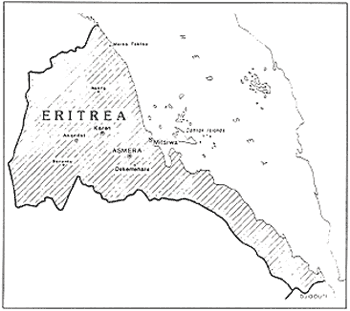 Women in the Liberation Struggle While the other Italian colonies attained independence, Eritrea was federated with Ethiopia in 1951. The federation was imposed by the United Nations, against the wishes of most Eritreans, in order to satisfy Ethiopia's desire for access to the sea and U.S. aims to establish a strategic communications base near Eritrea's capital, Asmara. The federation was unworkable from the start in its attempt to merge a democratizing Eritrea with the semi feudal monarchy of Ethiopia. Violations of the Federation Act were consistent and ultimately resulted in Ethiopia's 1962 annexation of Eritrea, a violation of international law. Since that time, Eritrea has been fighting for its right to self-determination. Particularly since 1974, the liberation movement has brought extensive changes to women in Eritrea. Previously women had supported the liberation struggle by providing food, shelter and information but with the emergence of the Eritrean Peoples' Liberation Front (EPLF) as the main independence group, women's participation has become more direct. Women have now taken up arms and are said to comprise 15% of the combatants. They also form 35 % of the EPLF in other capacities such as doctors, teachers, administrators, mechanics, technicians and organizers. In 1987 six women were elected to the seventy-one member Central Committee of the EPLF. There is general agreement that changes to traditional women's roles have been slower outside the EPLF and much work still needs to be done. Much of the impetus for change has come from the National Union of Eritrean Women (NUEW), founded in 1979, and composed of women inside Eritrean and abroad. Its goals include the emancipation of women through education, equality in health care and employment and the protection of women's rights within marriage. NUEW works with groups such as the Eritrean Relief Association (ERA) to establish literacy programs inside the EPLF-controlled territory. Colonialism and Literacy Literacy and education in Eritrea suffered under colonial occupation. During the first phase of the Italian period, education was restricted to the mission schools and only in the 1920s were primary schools opened for Eritrean children, who were even then not allowed to progress beyond the fourth grade. The curriculum taught only basic skills and emphasized the glory of Italian history. Girls were almost completely excluded from any process of formal education under Italian rule. |
| Back | Contents | Next |