|
During the period of British administration, the number of primary schools increased but they were segregated according to religion. Muslim schools taught in Arabic and concentrated mainly on studies of the Quran, while instruction in the Christian schools was in the Tigrinya language. This strategy also contributed to a division which the British would emphasize in their unsuccessful attempt to partition Eritrea between Sudan and Ethiopia. Under Ethiopian rule, Amharic was imposed as the official language of Eritrea. This directly contravened the terms of the UN Resolution which had federated the two countries and presented great difficulties to Eritrean students who had to learn a new language in order to attend university (today, similar problems exist at every level of study). Books in Arabic and Tigrinya were burnt and the Ethiopian educational system mirrored the Italian attempts to establish cultural hegemony by emphasizing the grandeur of the Ethiopian state. 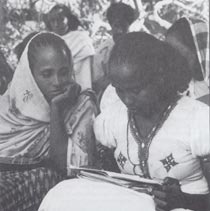
Despite the overthrow of the monarchy in 1974 and the ascension to power of a military junta (known as the Dergue in Amharic) led by Mengistu Haile Mariam and which professes to be Marxist-Leninist, Ethiopia's policy towards Eritrea remains unchanged. While U.S. interests determined that the Eritreans were denied independence, Soviet arms now flow to the Dergue in its campaign to bomb Eritrea into submission. Literacy Campaigns in Eritrea The EPLF places great emphasis on literacy in order to carry out its political education work; it stresses that every fighter must become literate. Women also have now gained the right to full education. Emancipation will not be achieved by an illiterate society and in recognition of this NUEW and ERA have worked together to bring literacy campaigns to the remote areas of the Eritrean countryside. Under the cover of trees or in camouflaged dugouts where they can avoid being seen by Ethiopian war-planes which patrol the skies and restrict much activity in Eritrea to the hours of darkness, women gather to study how to read and write. At the First International Conference on Eritrean Women held in Bergen, Netherlands, during March 1985, NUEW described the efforts it had made in bringing literacy to the women of Eritrea. A 1983 literacy campaign launched in 103 rural areas had reached 9,000 women. NUEM announced that its 1986 program was targeted towards 15,000 women in the provinces of Sahel and Barka. Frequently, the literacy campaigns involve the activities of cultural groups which enact dramatic presentations representing the aims and nature of the campaigns. Much of the literacy training, of course, has not gone past basic levels. However, in the Solomuna camp for those displaced by drought and war, some of the women have now reached the sixth grade level. Comments from the women involved in the literacy campaigns are enthusiastic. One woman said, "There is great joy in being able to read and write - in being part of the changes." Another said, "It was like being in the darkness and now I am beginning to see the light " One of the women who had fled her village when it was attacked by Ethiopian troops said, "Now I have learned to read and I understand the problems of my country. I can communicate in a way I could not before. I can do things like our cultural shows and handicrafts. Once you get educated, you fight things, and you tell others how to fight." Because Eritrean society consists of nine separate ethnic groups which speak mutually unintelligible languages, there are special problems in attempting to mount literacy campaigns. Books are being printed in all the written languages, but because a number of these do not have their own script it has been decided to transliterate material into Latin script. Additionally, literacy campaigns must be adapted to the circumstances of different modes of production. The basic division is between highland farmers and lowland pastoralists but there are numerous combinations of both forms of livelihood. Literacy campaigns in general must be geared towards the exigencies of various ways of life. For example, shorter courses have been designed to meet the needs of semi-nomadic groups. In agricultural areas, literacy classes have been timed according to the seasonal activities. There have also been longer and more comprehensive courses held in which women would be away from their homes and duties there for two to three months. After completion of the course, the women then return to their village to educate other women. Among the different ethnic groups there have been varying degrees of acceptance of the need for educational classes for women. |
| Back | Contents | Next |