|
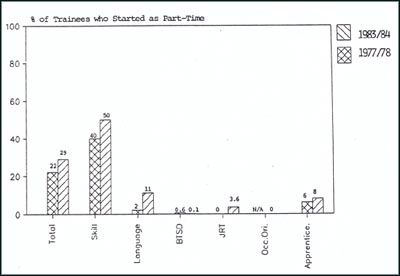
FIGURE 11 shows changes in the amount of part-time training
paid for under the National Training Act. Since women are most often
responsible for household and child-care tasks, access to part-time training
(as to part-time study) is an important option for them.
Although records do not reveal how many men or women are
part-time trainees, it is possible to establish the proportion who train
part-time and, from this, to assess the availability of this option.
From FIGURE 11, note:
- Part-time training in the Institutional Training programs
increased by a modest amount (from 22% of all Institutional trainees in
1977/1978 to 29% in 1983/1984).
- However, this level is still much lower than part-time
enrollment among university under-graduates (38% of all under-graduates).
- Most of the increase occurred in the Skill Training area,
where only 30% of the trainees were women.
- Occupational Orientation Training, with 81% women trainees
in 1983/1984, had no part-time trainees.
While these findings may reflect the choices of
trainees, it appears that no specific attempt has been made to accommodate
women's special needs and, thereby, to attract more women into training
programs.
This lack of accommodation of women's situation is echoed by
Boothby* who, for the same reason, criticizes the lack of dependent allowances
which reflect actual child-care costs.
* Boothby, D. Women Re-Entering the Labor Force and Training
Programs, 1986.
FIGURE 11
Changes in Availability of
Part-Time Training
Under the National Training Act
Note: No records are available on part-time vs. full-time
Industrial Training.
Source: Employment and Immigration Canada Annual Statistics
Bulletins, 1977/78 and 1983/84 |