|
E. Sue Rodriguez
Sue Rodriguez is a very controversial figure in Canada.
Throughout this group of activities it will be useful to try to figure out what
Sue models for us. Whether we agree with her or not, she stands for a set of
beliefs and a way of fighting for beliefs. We may be able to learn from her how
to fight for our beliefs, even if we disagree with her cause.
This story will generate a lot of discussion, so much that the
group may lose sight of the context, that is the Canadian legal system of the
late twentieth century. Sue's options were controlled and affected by the fact
that she lived in this time and place. It would be interesting to imagine what
would have been possible in other countries the students know. Consider
Holland, if anyone knows it, where euthanasia is legal under certain
circumstances.
Uncommon Will: The Death and Life of Sue Rodriguez, by
Lisa Birnie and Sue Rodriguez, is a book some students will be interested in.
Large parts of it are easier to read than a newspaper, and the story is
presented clearly and in an orderly fashion.
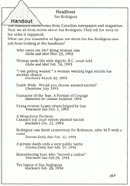
1. Previewing: "Headlines"
|
* * * * * * * * * * * * * * * *
This exercise
requires quite difficult reading. The headlines are full of words which will
need to be explained and perhaps learned. After you have constructed
definitions for them, make a crossword or have each student make a matching
exercise of some of the words and pass them to the next student to do. If this
is the first time your students have tried to write definitions, they will find
it difficult. You might do a set together.
If the vocabulary is too difficult, you may choose
to use only one or two headlines to introduce the story. Or you may choose to
write a few of the headlines in simpler language; when the students are
comfortable with them, compare them to the originals. The comparison is
important if at all possible. It helps student see that they are closer to
"reading" difficult material.
|
|
* Ask students to do the headlines exercise (page 187)
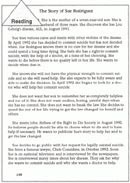
2. Reading: "The Story of Sue
Rodriguez"
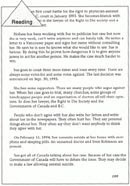
* Read the story with your group (pages 188 -
189).
3. Timeline and review
|
* * * * * * * * * * * * * * * *
This is a long
and possibly confusing story; making a time line will keep the details in front
of the class during the following discussion.
* * * * * * * * * * * * * * * *
These are
general questions that could be used to discuss anyone who struggles to change
social conditions. You might want to display them in the classroom. Use them
again in the guided discussion (E-4).
|
|
* Make a time line of the main events in her story.
* Review
the story by discussing these questions:
- What did her struggle to change the law cost her?
- Who helped her?
- How did she use the media, the government, community
organizations and famous people?
- Did she succeed, even partly?
- Who opposed her?
- Were those who opposed her respectful or did they try to
hurt or scare her?
- Do you think she was satisfied with the results?
4. Guided
discussion
* Some questions to consider:
- Do you admire Sue?
- What categories of role model does Sue fit into? Which
qualities did she have? (from activities A-2 and B-1)
- How are you like her?
- Can you think of any issue in your life or community that is
really important - something which really needs changing?
- Can you think of a woman who tried to change something in
her community? Tell her story, and use the questions about Sue Rodriguez from
Section E-3 to discuss it.
- You might know someone who would come in and tell your class
of a public struggle she went through. Interview her, asking some of these same
questions. Someone in your class may be willing to tell of some time in their
own lives when they fought for something.
5. Writing
|
* * * * * * * * * * * * * * * *
Some "rights"
are sure to come up that American citizens have, but Canadians don't, for
example, the right to bear arms, or the right to a telephone call if you are
arrested. There are interesting possibilities for research here into rights
people have in different countries.
Some students might be interested in finding out
more about federal and provincial human rights legislation, or inviting a guest
speaker such as a rights activist. (There are many groups fighting for rights
or advocating on behalf of their members - people with disabilities, First
Nations, lesbians, gays and bisexuals, animal rights, environmentalists, fat
people, short people, women, fathers, tenants and so on. Check your phone book
or watch your local paper for the names of people to contact.)
|
|
* You might introduce the activity by saying that Sue shows us
that how we act in our personal lives can affect what happens to our community
or country. Sue decided that what she wanted was something other people should
also have if they wanted it. She didn't think only of herself, and took
advantage of her right to speak out about her views.
* Invite students, individually or in pairs, to make a list of
all the rights they think we should have. A short list is started below. What
other things should be on this list?
- The right to vote.
- The right to physical safety.
- The right to practise your religion.
- The right to an education.
- The right to own personal property.
- The right to enter and exit the country.
* Invite students to write on any of these topics:
- What rights are you being denied that are on your list?
- How might you fight for your rights?
|