|
4. Paired interview: Silence and voice
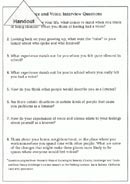
* Give students the handout "Interview Questions: Silence and Voice." * Ask them to take 20 minutes to interview one another in pairs, using the questions as a guide, making notes if they like. * Share the answers with the whole group. * Keep notes from the sharing session on an overhead transparency or on a flip chart or blackboard to demonstrate the many ways that people are silenced and the ways that experience affects their sense of themselves as knowers.
Researcher Mary Belenky has noted the link between violence and silence, taking violence in its broadest sense - physical, emotional, psychological. She and a colleague have developed this interview to stimulate reflection on the connections between being silenced, being voiced and seeing oneself as a knower. They define "being silenced" as the experience of someone fearing to speak because she may appear stupid, because she doubts her own authority, because she fears being attacked, physically or otherwise. They define "taking voice" as the experience of gaining the confidence to speak out about personal or public concerns. People may be silenced or given the possibility of taking voice in many situations - at home, in schools, in community settings, at work. This paired interview, like the previous one, helps students think about themselves as learners, as knowers and as experts. In this case, the focus is on the many instances of being silenced that all of us experience through life. My own classroom experience using this interview has shown that men often have similar experiences to women, though in different contexts. B. Drawing: A Link to Literacy 1. Drawing and writing
* Ask students to think about something that has importance or meaning for them. It could be an idea, a feeling, a memory, a dream, a nightmare. * Ask them to draw a picture and write about the same idea. They can write first and then draw, or draw first and then write. There are no rules, except that the writing and drawing should be personal. * You might want to show them the examples from other students,
from Drawing: A Link to Literacy by Catherine Bates and Linda Shohet * Invite students to share their drawings and writings with the group. * Some questions to consider:
The link between drawing and writing is usually confined to early childhood learning. The main research on adults' drawing outside of art classes has been done in art therapy. There has, however, recently been some thinking about using drawing and other forms of visual arts in regular learning situations. It is especially useful in literacy and second-language learning because it validates visual learners, gives those with less skill in language another form of expression and recognizes the graphic quality of letters and print on a page. Extending the link, researchers have pointed out that in the early stages of reading and writing, print and picture are part of a complementary whole. Giving older learners a chance to draw as part of their language experience can facilitate language learning, vocabulary growth and more. Many low-achieving learners have been shown to be highly visual. For poor readers and slow learners, drawing provides a way of literally "seeing" words, another way of getting to meaning. This approach is adaptable for all levels of learners and for many different contexts. It can be used for a single assignment or series of assignments designed to help students reflect on their own ways of learning. The drawings and writings should be ungraded and unjudged; they should be introduced only after a teacher or tutor has established a relationship of trust with the students and they have come to know one another. The approach can also be used as the introduction for a focused assignment in which you identity a theme or topic. |
 Answering these questions, especially about
places in their lives where they are silenced, can lead students to disclose
past or present experiences of violence and abuse. For some suggestions about
preparing yourself to deal with such disclosures, see "
Answering these questions, especially about
places in their lives where they are silenced, can lead students to disclose
past or present experiences of violence and abuse. For some suggestions about
preparing yourself to deal with such disclosures, see "| Back | Contents | Next |