|
A. Becoming Our Own
Experts
1. A learning style profile
* Ask learners to take 10 minutes to think about the following
questions, making notes if they like:
- What do you do best? Make a list. (The list could include
any skill that you have, any sport or instrument you play, any hobby at which
you are very good - hair styling, sewing, mechanics, etc.)
- How long have you been doing the things you listed? Note
each one separately.
- How did you learn to do each of these things? Again, note
each one separately. It is possible that they were learned in different ways,
for example, in a class, on a team, from a parent, relative or friend, or from
a book.
- From all the learning experiences you have had in your life,
including school, how do you think you learn best: by seeing something, by
hearing about it, by watching someone else do it, by doing it yourself or by
reading about it?
2. Paired interview: Experts
|
* * * * * * * * * * * * * * * *
Eventually, as
the class develops into a community, the members should be encouraged to
demonstrate their skills and even barter lessons among themselves.
* * * * * * * * * * * * * * * *
This play is a
powerful and ambiguous study of power, sexual politics and violence acted out
through a series of meetings between a male college professor and a female
student. She comes to see him because she does not understand his class, and he
is unable to answer her because he does not understand her situation or her
needs. The drama of their first meeting can spark recognition among many
students who can see a version of themselves in Carol.
* * * * * * * * * * * * * * * *
You might go
on, with your students, to brainstorm some subjects from their daily lives that
could be dramatized. Have them improvise scenes. If any of the scenes is
especially well done, write them down as scripts and give other students the
chance to act them.
* * * * * * * * * * * * * * * *
Some literacy
programs have developed projects around drama, for example, Setting the
Stage for Literacy: An Anthology of Student Scripts, by the Public Library
of Brookline and Adult Literacy Resource Institute.
|
|
This exercise is one of two paired interviews that help students
think about themselves as learners, as knowers and as experts.
* Ask students, in pairs, to interview one another about
learning history and learning style, using the questions from the previous
exercise.
* Ask students, in turn, to introduce their partners to the
group as experts at the things they do best.
* As students are introduced, keep notes on an overhead
transparency or on a flip chart or blackboard to demonstrate the many different
ways that people learn. The exercise also shows how much expertise we can
identify in one room.
* Photocopy and share the list of experts and put a large copy
on a bulletin board.
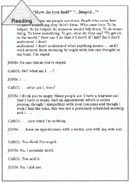
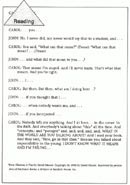
3. Reading: "How do you feel?'
". . . Stupid. . ."
* Introduce the excerpt from Oleanna, a play about
teachers and students and learning and schools and society (page 213).
* Read through the scene a few times.
* Ask two students to
play the parts of John, the teacher, and Carol, the student.
* When you
have heard several pairs of students play the parts, talk about their
reactions. Some questions to consider:
- Have you ever felt like Carol?
- What is John trying to do here?
|