|
* * * * * * * * * * * * * * * * *
To do these
activities, it will be helpful to have a copy of the book Getting There:
Producing Photostories with Immigrant Women, by Deborah Barndt, Ferne
Cristal and dian marino which contains photo stories of two women's struggles
to overcome isolation as newcomers to Canada, as well as a description of the
process by which those stories were produced. It also contains discussion about
immigrant women and work, and the influence of the media on women and men.
* * * * * * * * * * * * * * * *
Start by
covering the text and ask learners to tell the story as they see it through the
photos, or you may choose a related image (photo or drawing) and ask learners
to talk about that image. |
|
F. Transportation
1. Reading: "Gloria's Story"
* Pre-reading work can focus on discussion and attention to
sight words, and prediction. Helpful starting questions could include:
- How long have you lived here? in this city? in Canada?
- How did you feel when you first arrived? How do you feel
now?
- What do you like about living here?
- Is it difficult to go out to shop? to work? to visit
friends?
- How do you get around?
* For learners who have been together for a while, it may be
interesting to do some brainstorming or clustering around the words "isolation"
or "transportation."
* "Read" the photos, if you have a copy of Getting There.
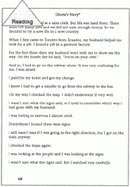
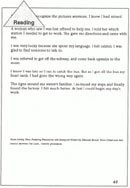
* Read and discuss "Gloria's Story".
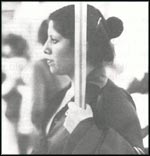
photo: Deborah Barndt |
 |
 |
|
* * * * * * * * * * * * * * * *
The author's
experiences in "Gloria's Story" have been shared by many women. In the story,
Gloria negotiates a complex public transit system, encountering print she can't
read, taking the wrong subway, finding help, until she finally reaches her
destination - her new place of employment. The book provides useful resources
for discussion and further writing and reading activity not only about women
and work, but also about the challenges women face when confronting new
situations.
* * * * * * * * * * * * * * * * *
After reading
the story, learners will probably have similar stories of their own to share.
For those learners who find little in common with the story, you might want to
ask them to share their own stories about how they do manage to function and
get around, and perhaps ask them to write some advice for others new to the
town.
* * * * * * * * * * * * * * * * *
Suggestions
for approaches to a deeper analysis of the problems of isolation and issues of
women and work appear in Getting There. |
|
2. Guided discussion
* These questions may help learners frame continued discussions
about some of the issues that arise in the text:
Gloria's Story
- What did Gloria need to be able to do to get to work?
- Did she have a problem? What was the problem?
- What did she do about the problem in the story?
- What do you think she did the next day - did she have
trouble finding her way to work again?
- What would have happened if Gloria hadn't got there?
Gloria and her husband
- Do you think Gloria had to rely on her husband to find a job
in Ecuador?
- How do you think she feels when he has to show her the way
to work?
- Do you think their relationship has changed since they've
come to Canada? How? Why?
On the bus
- Who do you think Gloria was likely to see on the bus?
- How do you think Gloria's bus driver gets to work?
- How does Gloria's husband get to work?
Public transit
- Who do you usually see when you use public transit?
- Who don't you often see on public transit? Why?
- Where do people here live? How do they get to
school/work/shopping centers?
- What's public transit like in our area? Affordable?
Convenient?
- If we have problems with transit, what can we do about them?
- What happens when no public transit is available? How do
people get around?
|