|
E. My Wife Doesn't Work
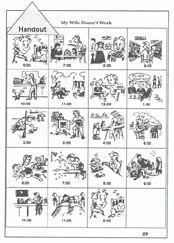
Work, both paid and unpaid, takes up a huge amount of women's time every day. Use the poster story (page 48) for the following activities. 1. Describing and sequencing * Enlarge the poster and cut it into squares, giving each learner (or group of learners) one or two squares. Ask learners to describe what is happening in each square, and then to discuss and write captions for their squares (working alone or with a partner). For example: At 6 o'clock she wakes up and goes to get the baby. At 7 o'clock she makes breakfast for the family. * Starting with 6:00 o'clock and working through the day, ask each learner or pair of learners to describe what they see in the drawings, then put the squares in sequence on a large sheet of newsprint. 2. Guided discussion * Some questions to consider:
* Learners may want to create their own collages, drawings or photomontages to re-create and describe their own day's work in or out of the house. |
| Back | Contents | Next |