|
D. Who Is Changing? This activity may be modified in several ways. As written, it asks students to scan a pile of newspapers, about a month's worth, to look for stories about individuals. If such reading is too difficult, the instructor might bring in twenty or thirty stories for the students to put into categories, or the students might use back issues of an easy-to-read newspaper, or stories clipped from it. It is not necessary for students to read and understand every sentence in the stories; they are only required to get the main ideas - headlines alone might be enough in many cases. As well, students will get a chance to read some of the stories four or five times, and discuss them with other students, so stories that seem difficult at first will become easier to read. The activity calls for two bulletin board spaces if there is a group of students. A tutor/student pair might make two scrapbooks of the stories. 1. Find the stories * Ask students to go through back issues of newspapers to look for stories about individuals, men or women or children. The only stipulation is that the story must be about a person. For example, a story about the latest developments in a war, what the UN involvement is and where the lines are now drawn, is not appropriate to this exercise, but a story about one soldier's heroic or heinous deeds will work. * Find as many stories as possible. 2. Sort the stories * Sort the stories into two groups, those about men and those about women. * Half the students should take the stories about women to one bulletin board space, and half take the stories about men to the other space. The groups of students should be of both genders.
* Ask each group to sort their stories into several categories:
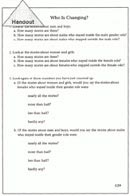
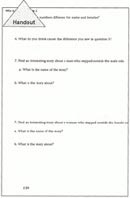
* Encourage the students to discuss the stories and decide what category each belongs to. * Feel free to add categories as needed. * Ask students to display their stories on the board in groups with the categories labeled. * Be sure that the display or scrapbook makes it is easy to see what stories belong in which categories. 3. Analyze the stories * Divide the students into pairs; ask each pair to take the stories in one of the categories, either on the male side or the female side. It doesn't matter what sex the pairs are. * Give every pair a set of markers - ribbons, sticky dots, sticky tape, coloured pins or whatever - in two colours. One colour is to mark stories in which the person followed the accepted gender model for his/her sex; the other color is to mark stories in which the person stepped outside the accepted gender role. * Ask the students to analyze each story, jointly decide if the person stayed inside the appropriate gender role or stepped outside it, and mark the story with the chosen colour. * When a pair of students has marked all the stories in one category, they can take another category that has not been done yet, until every story has been analyzed. 4. Read the displays * Hand out the question sheet "Who Is Changing?" * Share the answers.
Individuals can work on their own sheets if their skills are high enough, but pairs or small groups can work together, with one person writing the answers, if that suits their skills better.
|
| Back | Contents | Next |