|
E. Personal Development
1. Writing
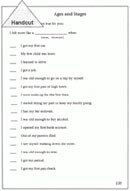
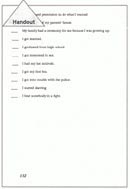
* Hand out the checklist "Ages and Stages."
Ask them to fill in the blank at the top of the page with "man" or "woman" as
appropriate.
|
* * * * * * * * * * * * * * * *
 In the field testing, some students were
upset about parts of the checklist that refer to sex and menstrual periods. You
may want to take those items off the list before you give it to students, or
stress in advance that students do not need to share their answers with anyone,
and that the checklists will not be posted or handed in. In the field testing, some students were
upset about parts of the checklist that refer to sex and menstrual periods. You
may want to take those items off the list before you give it to students, or
stress in advance that students do not need to share their answers with anyone,
and that the checklists will not be posted or handed in.
|
|
* Ask students to check things that were important to them as
they grew from a child to a man or woman.
|
* * * * * * * * * * * * * * * *
Students may be
interested in writing several pieces, each piece about one of the things they
checked off.
* * * * * * * * * * * * * * * *
You might want
to notice if there are any patterns in the group. Were there things, such as
learning to drive, that both sexes do, but that seem to be more important to
the image of one sex than the other?
* * * * * * * * * * * * * * * * *
Hats
is a delightful book from the Adult Literacy and Basic Skills Unit, London,
England. Eleven pieces of poetry and prose cover such themes as women's roles
(the hats they wear), the constrictions of life as a housewife, a woman's pride
in her daughter becoming a plumber, friendship, a single mother who is a truck
driver, and so on.
|
|
* Then ask the students to pick one of the items that they
checked and write about it, for example, their bar or bat mitzvah, or the day
they got their first car. The important point is that they write about one
specific thing.
* Share the writing in the usual way.
2. Reading: Hats
* Read some or all of the selections in Hats.
* Suggested activities:
- Read selections aloud and discuss them.
- Ask students to read them to each other, or to read a
favorite part to the class.
- Use some of the pieces as a Readers' Theatre production.
- After you have read some or all of them in class, ask
students to pick a favorite selection to perform for the class as a whole.
- Ask students to write similar pieces to talk about the roles
of women they know.
- Ask students to write similar pieces about the roles men
play.
F. How Are We Changing?
1. Make a list
* Divide your students into two groups, men and women.
* Ask each group to make a list of things the group members do
which their parents or their grandparents did not do.
* Ask them to think of reasons for these changes.
* Each group should make a presentation of its list and reasons
to the other group.
2. Writing
* Ask students to write on one of the following topics, or on
any other that grows out of the previous discussion:
- I can do many things my mother/father could not do.
- I have more freedom than my mother/father.
- Life was easier when roles were clearer.
- Changing gender roles cause big problems for everybody.
- The world is a better place when everyone has more freedom
to choose.
- Men and women should stay in their places.
- My children will be able to choose for themselves.
* Share this writing in your usual way.
Resources
The following books deal with the theme of gender roles, and are
at a literacy reading level.
(See the Bibliography for
complete listings.)
English, Betty Lou. Women at Their Work
Holt, Julia
et al. Hats
Keller, Rosanne. Woman's Work, Man's Work
Participatory Research Group. Women's Kit. "Women's Days" and
"Housework"
Reed, Fran. A Dream with Storms
Reiff, Tana. A
Place for Everyone
Reiff, Tana. The Door is Open |