|
B. Roles of Men and Women
The objectives of this section are to explore learners'
perceptions about the responsibilities of men and women, to compare the roles
of men and women in Canada and other countries and to talk about
non-traditional roles and their significance in different cultures.
1. Guided discussion
|
* * * * * * * * * * * * * * * *
There are two
activities here. Pick one or the other to do with your group. If you choose to
do the first activity, you will need a collection of pictures of men and women
in non-traditional roles, preferably from various cultures. You could collect
the pictures yourself, or invite learners to collect them.
|
|
* Look at the pictures, especially any of men and women engaged
in different household chores. What do you see in each picture? Some questions
to consider:
- How do you feel when you see men and women in
non-traditional roles?
- Are role-reversals acceptable or common in your culture?
- What are the defined roles for men and women in your
culture?
OR
* Elicit from the learners a list of various household chores or
tasks, for example, shopping, cooking, putting up a book shelf, taking out
garbage, washing the car.
* Invite learners to classify these tasks according to gender
roles and share their categorizations.
- Who is responsible for these household duties in your
culture? A man or a woman?
- What about in Canada? How does your culture compare to that
of mainstream Canadian culture regarding this issue?
2. Reading: "Stay-at-home Dad"
|
* * * * * * * * * * * * * * * *
 This reading was an emotional experience for
a group of intermediate learners who had been together for two years. They
responded in the following ways: They did not understand the word "dad." One
Portuguese woman started thinking how she had never understood or related to
her father. Her only feeling for her father was fear. A Portuguese and a
Chilean woman described similar experiences with their fathers. The first
Portuguese woman was so overwhelmed that she cried. This reading was an emotional experience for
a group of intermediate learners who had been together for two years. They
responded in the following ways: They did not understand the word "dad." One
Portuguese woman started thinking how she had never understood or related to
her father. Her only feeling for her father was fear. A Portuguese and a
Chilean woman described similar experiences with their fathers. The first
Portuguese woman was so overwhelmed that she cried.
A male learner did not understand why a man would
want to stay at home to take care of his children. He asked if the mother was
sick.
A Portuguese woman had never heard of or seen men
doing grocery shopping. Even though this is not done in her country, she seemed
to be quite supportive of the idea.
A woman shared with the other learners her
aspiration to become a mechanic when she was in her country. She repaired cars
with her father, but nobody would take her seriously. In response, a male
learner in the group said that it is indeed a dirty job. The woman retorted,
"Who cares?"
|
|
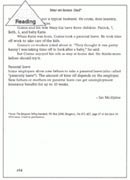
* Read the story to the learners and ask them to share what they
have heard (page 102).
* Distribute the text and ask learners to read silently and
underline words that they do not understand.
* Ask learners to take turns reading aloud a part of the story.
When necessary, for example, after every turn, the teacher should ask
comprehension questions or explain new words.
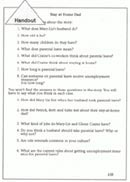
*Ask learners to do some or all of the comprehension questions
on this story (page 103).
3. Reading: "Who Does the
Housework at Your Place?"
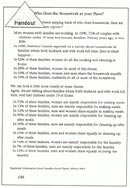
* Read and discuss the statistics from the article (page 104).
Where in these figures does each learner fit?
|
* * * * * * * * * * * * * * * *
Notice that the
percentages in each case do not add up to 100%. Learners will have to put an
"Other" category on their graphs. There is room for some interesting
speculation there.
* * * * * * * * * * * * * * * *
Depending on
the skills of learners, I ask them to write their own stories, or I use a
language experience approach with the group or with individuals. When learners
draw and present their drawings to the class, there is lots of opportunity to
practise speaking and listening.
|
|
* Ask learners to make four bar or circle graphs showing how
housework gets done in families where two parents work. Titles for the graphs
might be:
- Who does the housework?
- Who makes the meals?
- Who cleans up after meals?
- Who does the laundry?
* Ask learners to write or make a drawing about some of the
discussion questions from the guided discussion, above, or on these topics:
- Who does the housework at home?
- What are the usual roles of a husband and a wife in your
culture?
- Have you rebelled against those roles or stuck to them? How?
- Are these responsibilities similar to or different from
those of other couples in Canada?
|