|
C. Controversy
1. Agreeing and disagreeing
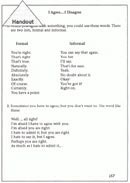
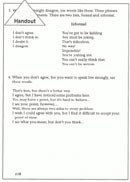
Review or teach vocabulary we use in agreeing and disagreeing
(page 105). Then present each of the following proverbs
or popular sayings, one at a time. Read the statement to make sure that
everyone understands it, then do a round where each learner responds, using
phrases from the vocabulary presented.
- Women with young children should not work outside the home.
- Men do not belong in the kitchen.
- Men should be responsible for the main income of the
family.
- Mothers with young children should not work.
- Both women and men should do housework and cooking.
- A woman's work is never done.
- Men must earn more than women although quality is the law.
- Men and women talk differently.
- Women always have the last word.
- Girls are sugar and spice and everything nice.
- Boys are snakes and snails and puppy dogs' tails.
- Silence is consent.
|
* * * * * * * * * * * * * * * *
If formal
presentations aren't suitable for your learners, substitute an informal
discussion after the round.
|
|
2. Debate
* Pick one of the statements from the preceding activity for
further discussion and ask learners to make a formal presentation. Each learner
prepares a statement in which he or she takes a stand, either agreeing or
disagreeing, and explains why. Then learners take turns presenting their
statements.
* After the presentations or discussions, discuss the following
questions:
|
* * * * * * * * * * * * * * * *
I learned these
activities from Sigrid Anderson. A variation is Gut Reactions (i.e., first
thoughts, feelings, ideas, impressions). Stress the fact that you are
interested in gut reactions. Emphasize that there is a time limit to their
responses.
|
|
- How did you find the discussion or the presentations?
- Was it easy to take a stand? Why or why not?
- What does that say about our inclination to follow our own
thoughts, rather than to listen to what others have to say?
- What influenced you (for example, your opinions, the
reactions of others, facts, experience)?
The teacher demonstrates what is expected of learners by giving
a statement and eliciting some gut reactions. The statements above are read and
explained if necessary. Learners write down their responses, which are
collected and displayed. At the end of the activity, learners talk about their
responses and discuss the objective of the exercise. |