|
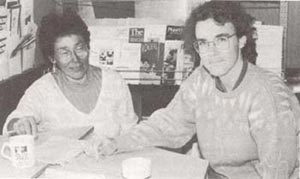
Several women stressed the importance of developing commonalities with students, and building trust by talking about their own experiences. I would say that a woman coming into the classroom first time would feel quite intimidated because here I am a white woman - not only white, but free. I'm free to come and go as I please. I think that could be pretty intimidating. . . The thing I use to break down that difference between Native and non-Native is experiences...I can share about the same experiences that they have experienced and all of a sudden the walls kind of just drop and they are able to say, "Yeah, it's not the fact that she's white that she's separate from us." The fact that I have experienced similar situations and am able to share with the women breaks down that barrier. . . . I have to be the one to share first and talk to them about how I feel, or how I felt about certain situations and then they feel okay to risk. (LaVera Schiele, Pine Grove Correctional Centre) At the same time they stressed that we have to be aware that the same experiences can affect us very differently. Being called a cunt doesn't feel any nicer for a woman staff than it does for a student. Being called a slut. It doesn't threaten me as much, though, because I am staff. I might have to deal with the violent part of it but I'll eventually get some support. The woman student may have to go stand on the same street comer to find shelter tonight. . . . This woman is going to , have to go out on the street and deal with him. So if he's angry at her she can become a victim again and again. (Pat MacNeil, Beat the Street) And we have to be aware that we have power in the classroom. We have to be very careful not to impose our values on students, particularly when we are working with women from cultural backgrounds different than our own. If we start questioning a woman's relationship to her husband because from our point of view it's really a sexist relationship - what is that saying to , that woman? Leave your country, leave your family, leave your culture, leave your customs because we have the right way you should be living? Go on welfare? That's the reality. Instead, what we're offering is options. (Paula Davies, College of New Caledonia) While we were working in widely differing contexts and with a range of activities defined as "woman-positive," some of the most striking learnings from this research resulted from paying attention, often for the first time, to the specific needs of women in the program. I learned that women all across Canada live the same kind of lives. Even though we're different races, different ages, different class, we all have a lot of common ground. I learned that literacy is really, really important and it's also very difficult for women. A year ago I would not have thought that literacy was harder for a woman to achieve than a man. (Debbie Heagy interview, WEST) We sat at the Kitchen table
and helped each other. |
| Back | Contents | Next |