|
The Women's Upgrading Program
Arviat is a hamlet of 1,300 people located on the west coast of Hudson Bay, approximately 300 air miles north of Churchill, Manitoba. Arviat is not on a road system. It can only be reached by airplane or skidoo in the winter and by airplane or boat in the summer. Ninety percent of the population is Inuit. 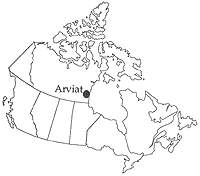
The economic base is government jobs and welfare, with some private sector development such as a Northern Store, a Co-op Store and Motel, a lumber supply company, a construction company, and a locally-controlled Inuit development corporation. Community agencies include a library, drug and alcohol centre, Catholic Church youth program, community radio station and many volunteer committees such as youth justice and health. The school has grades K to 12. The people's lifestyle in Arviat is a blend of traditional and modern ways. For example, traditional practices such as fishing, hunting, and making clothing out of animal skins are widely-practiced and valued skills. Many people depend on the land for food subsistence and for maintaining traditional life and culture. Inuktitut is the first language of most Inuit and is used in daily life. While many people hold a romantic view of the North, in reality the community is a blend of stark contrasts. There is wealth, but also poverty, and some people often do not have enough to eat. There is beautiful scenery and disturbing sights of neglect and garbage. Many people are bilingual in English and Inuktitut. Some are literate in neither. Arviat fought for, and recently succeeded in getting, a public education program up to grade 12. In 1991, seventeen students graduated: ninety-five percent of the high school graduates in Keewatin Region of the Northwest Territories. On the other hand, there is a significant attendance problem in elementary school. The public education system is developing and there is common recognition that the system generally fails to produce enough people ready to go on to the higher education and training needed to prepare the Inuit for the management of their homeland. "Here's me Just being me. On one side Ellen is gently chiding me for being feminist and I feel almost obligated not to let her down, while carefully avoiding whatever degree of strident fervour might offend her. On the other side is Val, whom I'm also trying not to alienate or carry against her will into foreign waters. And I'm trying to stay within these imaginary lines without even knowing how the lines are defined in their minds and, sometimes, in my own mind. When Val finally reveals her hand, I realize I assumed a lot of things that weren't even true. If this is happening amongst only three women, the complexities amongst all women is too overwhelming to consider! Has the word "feminist" created half the battle? Karen Bergman-Ilinik, "Charting the woman-positive ripples - A journal of discovery" |
| Back | Contents | Next |