|
A series of themes
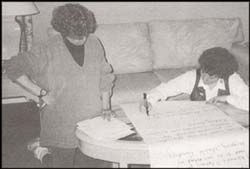
Paula
Davies and Mary Ann Tierney had already noted themes in the documentation
before they arrived at the workshop. Here they consolidate their work and look
for further issues |
Paula Davies and Mary Ann Tierney (College of New Caledonia) had
both been making notes of different issues as they read the documentation. They
worked together at this workshop to make their list more comprehensive and to
recognize where they found similar and dissimilar themes. They wanted to
include not only the most evident themes, but also those that somehow remain
hidden in the text. In the process, they said, they realized how easy it was to
find themes that interested them. Pieces that had less meaning in their own
programs took more effort to highlight. Later in the day, they presented their
list to all the women.
- Good literacy work is woman- positive.
- Women literacy workers have a holistic sense of
responsibility. We deal with more than the academic needs of our students.
- Because good woman-positive literacy work is holistic,
literacy workers require funded time to develop such things as support services
and curriculum.
- Women's literacy programs need be validated by on-going
stable funding that includes counsellors.
- What we discovered through this research needs to be
translated into practical funding terms.
- We devalue our own work by not asking for - by not demanding
- the dollars and space we need to provide good woman-positive literacy
programming.
- This kind of research has many effects on the women involved.
For example, the researcher can become the focus of the research, she can
experience pain, difficulty, questioning, joy, hope.
- Being affiliated with CCLOW through this research gave us
validation and permission for our work.
- Many women explored the relationship between feminist and
woman-positive, and learner- centred. Some discovered that women-only is not
necessarily woman-positive.
- Several women struggled with feminism as content. They came
to realize that feminism must become more accessible.
- Violence is an almost overwhelming issue for women in
literacy.
- Isolation is another overwhelming issue - isolation for women
students, for women workers, for programs.
- The social aspect of learning is central for women.
|