 |
National Features
Articles de fond |
NVO MONTREAL ECONOMIC FORUM
THE GOVERNMENT'S ECONOMIC AGENDA:
VOLUNTARY ORGANIZATIONS
RESPOND 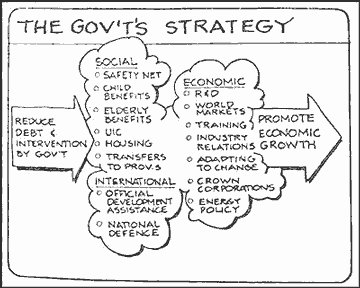
In November 1984, the federal government tabled its Economic
Agenda for Canada and invited public discussion of new directions for the
country. Since then, many organizations have been reviewing and commenting on
the implications of the directions proposed by the government for economic
renewal. Part of the consultation process with all sectors will culminate in
the Federal Economic Summit in March. Lisa Avedon, president of CCLOW will be
participating. In preparation for the summit, National Voluntary Organizations,
including CCLOW and 58 others, met in January to discuss the national issues
arising from the agenda and to develop a voluntary sector response.
CONSENSUS
A high degree of consensus emerged in three areas:
- The roles and relationships of Canadian social and
economic partners need to be re-examined if there is to be any consensus
achieved on broad national issues. The voluntary sector, labor, big business,
small business and government all have very different, but complementary
characteristics. Each partner in the relationship must be strong and
independent to enable joint planning which builds on the strengths of each
sector. The government must show leadership in removing barriers which hinder
the effective operation of each sector, and provide the kind of support and
guidance which allows each sector to function independently before they can
become truly interdependent.
- A government committed to deregulation should change the
rules governing charitable activity to enable more effective advocacy and
service by Canada is voluntary sector. While this sector has long been one
of the most innovative in Canadian society and has provided very efficient
provision of services to communities, the dependence of the sector on
government for both funds and freedom hampers the growth of one of the most
significant potential partners to economic growth and new
employment.
- Except for its non-profit nature, the voluntary sector
should be seen in the same light as small business. It is labor intensive,
a producer of innovative new services in communities, and has demonstrated a
capacity for social entrepreneurship unmatched by any other sector.
SOCIAL PROGRAMS
Women's Organizations and others at the Forum defined three
major
principles to be put forward in discussions of social programs:
- That universality be maintained;
- That redistribution of benefits to those most in need be
done through tax reform, rather than compromise of
universality;
- That voluntary sector involvement should be strengthened
in the planning, implementation, and delivery of social programs,
in
preference to increased government involvement.
|