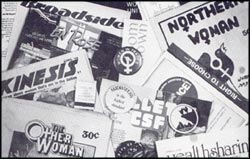
Aisla: Where do you think the Canadian women's movement begins? CWMA: Our collection definitely focuses on the contemporary women's movement beginning in 1960 when the Voice of Women was established in Canada. I think that contemporary material is not often seen as archival by traditional archivists, so it's more likely to get lost; it's not seen as old and yellowing. Aisla: So is that one other reason you think you are different from more traditional kind of archives such as the Public Archives in Ottawa? CWMA: I think it' s important for feminists to be saving this material, because we appreciate the range of the women's movement, in a way that I think traditional archivists couldn't. So small groups that haven't done very much, might just look like "nothing" groups to traditional archives, because they don't have many records. We also collect material in a different way from traditional archives. Normally, with traditional archives, you deposit a collection of material. We get material that way; but we also get material in bits and pieces -- minutes after each meeting, or a new leaflet as it's produced, that kind of thing. And we're organized in such a way that it' s possible to integrate that material much more easily than in the traditional archives. Aisla: We seem to use the phrases "women's" and "feminist" groups as interchangeable expressions. What is the definition you apply? CWMA: One day the collective had a potluck in proper feminist fashion and defined the women's movement over dessert. We put a lot of onus on self-definition, on what the group considers self; beyond that, we usually consider to be part of the women's movement any organization that has as one of its primary goals the improvement of women's social, economic, or political condition. That allows for certain flexibility. Aisla: About how many groups do you currently have association files on? CWMA: We have material on approximately 1500 organizations, and we have 500 to 600 periodical titles, including periodicals, newsletters, journals -- all Canadian. Aisla: Was there a founding mother, or founding mothers of the collection? CWMA: There is a founding mother. Her name is Pat Leslie. Pat was very active with the Toronto women's newspaper in the mid-70s, called The Other Women. When it ceased to publish in 1977, Pat took all their material, moved it into her house, and decided to make it the start of the Canadian Women's Movement Archives. Until 1982 it was in Pat's basement. It's thanks to her that this collection exists. In 1982 we incorporated, formed a collective, and moved into a public space. It was one filing cabinet; it's grown to include 15 filing cabinets, 15 shelves of periodicals and a small resource centre. Aisla: Why did you work as a collective? CWMA: Partly we see ourselves as part of the women's movement and partly because the collective structure allows each of us to participate equally. Aisla: Could you give me an idea of some of the kinds of materials housed in the Archives? CWMA: Anything that is produced by the women's movement in Canada, which helps to document the work that women have been doing in the women's movement: flyers, buttons, T-shirts, periodicals, photographs, minutes, tapes. My favourite example is the two brass plaques that were originally from Dr. Morgenthaler's clinic and were defaced by anti-choice protesters and were taken down and given to us. There's simply nowhere else to put them. It's hard to imagine them in the National Museum of Man, or the Canadian Museum of Anthropology! Photographs are really an important resource. Photographs identify an event which happens and then it's gone. I think the women in the women's movement need to take more photos of their activities, demonstrations, whatever. There a very powerful record of the women's movement in Canada. |
| Back | Contents | Next |