|
Aisla: Do you have any material on women's education, educational association, programs, anything else you could see directly related to women's learning? CWMA: In some ways, the women's movement is about education. I mean, everything is about educating, either women themselves or, more frequently, men or whomever else. Aisla: So you see the archives as an educational tool. Is that one way you describe it? CWMA: A lot of our material is from organizations which have as part of their mandate to educate women. So it's educational material in that sense as well. Aisla: Do you see potential for some of the archival materials to be used by teachers, or people working in women's studies classes, to teach students about their own history? CWMA: We have done one thing in that area, a project we call Graphic Feminism, which was a show of women's graphic art. The original show wasn't limited just to posters; it also included book covers, graphics, buttons and journals. I think that has real potential for giving a sense of the women's movement and the issues that are raised. And some of the feeling of the women's movement comes across quite vividly in the posters. That show, by the way could be moved. The posters are organized in such a way that if a group were wishing to display it, it could be arranged. Of course, they would have to pay the transportation and shipping costs. Aisla: Are there any gaps in the collection that need to be filled? CWMA: We certainly have material from across Canada, but we don't have the amount or the breadth of material that we do from Toronto. Areas that we are trying to be particularly sensitive to because they tend to get lost some- times are women of colour, lesbian groups, immigrant women's group, francophone groups, and native women's groups. 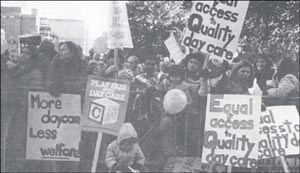
Aisla: Are there any similar kind of archives anywhere else, that you know of? CWMA: Probably one of the best known ones is in New York City, the Lesbian Herstory Archives. Obviously, given their name, they collect lesbian material; but it's maintained independently, in a women's apartment actually; they don't even have a separate location, they live in the midst of all this. There are also other women's archives in Europe -- in Denmark, Amsterdam and Germany. There are also lesbian archives in Kenora and Montreal, and there is also a women's archives collective in Vancouver. There's another one we're really proud of. When we were traveling. for a project we were doing, a group of women in Sydney Nova Scotia got very interested and have since formed the Cape Breton Women's Movement Collection that's deposited at the University College of Cape Breton. It's a reasonably small collection by our standards; they've got maybe six or seven groups represented in it. But it's a tremendous start. Aisla: So you think you could act as a model for other, more regional or smaller centers, to do this within their own community, or even in a larger area. CWMA: We'll provide any kind of start-up advice if a group wants to get going. We also get letters from individuals asking: Do you have this kind of material; What do you have? We're happy to deal with those kinds of requests. We are in the position, if people are patient with us, to respond to inquiries in French. Aisla: How can women from across Canada access information that's physically located here, in Toronto? |
| Back | Contents | Next |