|
THE RESOURCE BOOKLET "Poverty in B. C" didn't turn out to be a curriculum unit in the technical sense. It is a 23 page booklet full of facts and statistics on poverty, speaking of the "other side" of life in B.C. and in Canada. The facts are startling: "As the National Council of Welfare report, Poverty on the Increase (March 1985) points out, certain groups are particularly vulnerable to poverty. Half of families headed by women are poor. Almost half of unattached women (who live alone or with non-relatives) are poor (the feminization of poverty). Half of unattached Canadians below the age of 25 were poor at last count, as were 50% of unattached elderly. One in three families headed by persons under 25 are poor". (Poverty on the Increase, page 1) The booklet deals with the extent of poverty in B.C. and Canada, focuses on unemployment and its social costs, child and youth poverty, and the gap between the rich and poor. It has an essay from a 14 year old girl living on social assistance who writes: "I guess (my) friends expected that someone on welfare is supposed to be dumb, ugly, and inactive." The booklet has a whole section on how poverty and unemployment can be eliminated. The philosophy of this section, and also of our coalition, is that "poverty and unemployment exist because government and Canadians in general allow them to exist." It quotes E.F. Schumacher: "There is no economic problem and, in a sense, there never has been. But there is a moral problem." This section points out that "It is a question of choosing the priorities in the social and economic life we live together which are closest to the values we hold as human beings. The choices we make will tell us a great deal about ourselves, and those choices, fundamentally, are ethical." The second half of the unit is devoted to student activities which can be done in the class- room. For example one of the exercises reads:" You have a job which pays minimum wage. You are living away from home, and no well-off relative is able to help you. Work out a budget on a monthly basis." Another exercise deals with unemployment: "You were employed for ten months, and then laid off. There were 20 people applying for every job you applied for. Finally, to your humiliation and anger, you went on welfare. You began to receive $350 a month. Work out a budget for yourself." There are suggestions for teachers, and a list of print, video, and community resources, including a list of Unemployed Action Centers and anti-poverty groups throughout the province that teachers can call on for first hand information about poverty and unemployment in their area. EVALUATION What did we hope to accomplish with our little booklet? First of all, our coalition takes every opportunity to draw attention to the issue of growing poverty in B.C. and Canada. We want people to acknowledge this often ignored issue so we can begin to take measures to end poverty. Simply announcing that we were writing the resource booklet helped in this area. The media were quite interested, and our approach provided a good contrast to what the provincial government was planning. Now that the booklet has been produced, anti-poverty groups, churches, and unemployed action centres throughout the province will be able to approach their local School Boards to ask them to officially adopt or use it in local schools. For example, End Legislated Poverty organized delegations which appeared at a Vancouver School Board meeting supporting the unit. The School Board adopted it, and plans to include the booklet in its professional development programs. 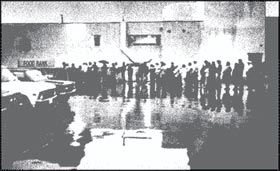
Secondly, teachers really had no one stop source of resource material on this issue. Various business groups had already provided kits and binders full of specific curricula and information from the free enterprise perspective. Teacher told us there was really nothing on poverty and unemployment, yet there were several places where it fits nicely into the official curriculum. For example, in the grade 10 curriculum there is a section on economic activity and its effect on Canadians, as well as the development of the Canadian economy and the importance of active "responsible citizenship." The grade eleven curriculum deals with government, law, politics, and social issues. So our curriculum unit will help fill a gap in that area for teachers. So far the booklet has been approved by the Vancouver and New Westminster School Boards. Many teachers' associations are aware of it and helping teachers to use it. Individual teachers have already used it - in high schools, community colleges, churches and study groups. And lastly, of course, students will have a chance to think both in school and when they get out of school, about an issue that is increasingly relevant in their own lives.
|
| Back | Contents | Next |