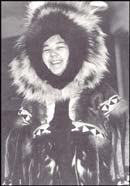
Sally Karetak, museum development officer at the Inuit Cultural Institute in Eskimo Point, became my assistant co-ordinator. We discussed possible ways of presenting the clothing and decided that a live show would be most effective. It would eliminate the need for costly mannequins and reduce shipping costs. It would also reinforce the fact that caribou skin clothing is a practical, vibrant part of contemporary Inuit culture. The first show was in Eskimo Point. The audience appreciated our efforts but after it was over we had a thousand ideas for improving the performance. During the next two months Sally and I traveled with the clothing to each Canadian Arctic region as well as to Manitoba, Ontario and Quebec. In each community we contacted Inuit who volunteered to model the clothing. Finding models was not always easy. For example, in Rankin Inlet, our show was held on the same night as a hockey game and it was impossible to find a male volunteer. Luckily an elderly man came in to watch and we begged him to join us on stage. He soon became the star performer. With a twinkle in his eye he said the next time he was having tea in an igloo with his hunting buddies, he would have a good story to tell. Joachim Ayaruak stole the show in Winnipeg. Joachim answered many questions from the audience and at the end said, "Today I feel like a real Inuk (Eskimo). I feel really good about in my way of life." Joyce Komaksuitiksak agreed: "The main reason I want my daughter, Jamie, involved in this show is so she grows up feeling proud about her culture." Micheal Haqpi, from Baker Lake, planned his holidays around modeling when the show was in Winnipeg. Afterwards he said, "At first I was nervous, but once I began to answer peoples' questions I started to feel good about myself and my culture. Now I feel like this was the best day of my life." Similar comments were repeated by Inuit models in Toronto, Montreal, Ottawa, Iqaluit, Eskimo Point, Cambridge Bay and Yellowknife. We were invited to perform at the Glenbow Museum in Calgary during the Winter Olympics and at the Winter Cities '88 Conference in Edmonton. Joachim came to Calgary to model in the show and said, "Inuit Annuraangit provides a great opportunity to meet people from other cultures, to see new places, and especially to share our culture with people from allover the world." Joyce Ayaruak summed up the feelings of many models when she talked about what she and her children had learned by participating in the performance. She said, "The audience really likes us. That has helped us develop poise, confidence, pride and an ability to answer questions on stage. This hands-on type of training is the best kind of education." The most rewarding part of the performance, from my perspective, is seeing audiences share my admiration for the exceptional skill of Inuit seamstresses and seeing the model's pride glow from their eyes as they answer the endless stream of various questions. Skin clothing not only keeps hunters warm in one of the harshest climates of the world, it is an ideal educational tool that has warmed the hearts of many Inuit and non-Inuit who have participated in Inuit Annuraangit. |
| Back | Contents | Next |