|
First of all, we needed to better understand our basic assumptions about what constitutes an effective decision. We came up with the following: 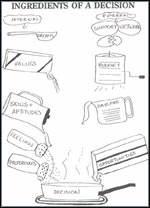
With these assumptions in mind, we began to examine our current approach. What follows is a discussion of the major problems we found and the strategies we developed in response. Problem # 1 Too little time allowed for decisions However, when we reviewed the OFA program we realized that, in fact, many other sessions dealt with the decision-making task. Making these connections explicit to participants would, we felt, make the task easier and present a truer, more effective model of decision-making for participants to adopt. Response: We decided that throughout the OFA program, facilitators would help to clarify the links between the content and the task of decision-making. For example, in Session 3 participants are encouraged to daydream about what they will be doing in four years and to identify new hats or roles they would like to assume. Their dreams then become clues to be considered as part of the decision-making process. In Sessions 5-7 on Assertiveness Training, facilitators clarify the practical relation between being assertive and being able to change one's life. Each group generates a Bill of Rights which includes the right to make decisions for oneself and in one's own interest. Participants develop the assertive skills needed to research their options. Session 9, The Ingredients of a Decision, presents a framework for cataloguing all the information needed to make an effective decision. During Sessions 9-14 information is gathered on personal interests and various relevant community resources including education, training, volunteer programs, etc. Participants are reminded throughout of the connection between this information and the decision they will be trying to make. Session 14 and 15 builds participants confidence and helps the group explicitly identify their decision-making strengths. Finally, Session 16 presents a process for assessing the information, making and verifying a decision. |
| Back | Contents | Next |