|
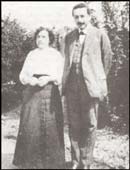
Mileva broke off her own doctoral studies to work with Albert and be his patron. As she put it: "We are ein stein, one stone." Just because Albert Einstein demeaned, by taking advantage of the collaborative oneness he enjoyed with Mileva shouldn't cause us to devalue the cultural priorities with which Mileva shaped her life and pursued her science.
Vestiges of this pre-modern scientific culture survive today. A significant number of women scientists in Dagg and Beauchamp's study reported that their approach to research was more collaborative than their male colleagues, and that they paid more attention to relationships within their research group. One said: "I always share my methods and ideas, and am repeatedly shocked and surprised when a male colleague withholds or protects information." But why does this difference in doing science as social process and social relations persist, especially among women? It may be explained simply by the fact that when modern science followed modern economics out of the home into the "public" sphere of specialized institutions, women as a group were left behind. As long as women continue to do science in a way that reflects the orientations associated with household activities, they will also be preserving and applying the vestiges of a pre-modern scientific mindset. This brings me to the third, and possibly the most subtle, of the looking-glass differences I want to discuss here: the orientation of the individual scientist in seeking to know the world scientifically. Science in tribal society was embedded in the context of everyday life. It was the science of roots and the technology of digging sticks fire-hardened by women to get at those roots. It was the science of plants women cultivated from seeds they selected from the best they found in the wild It was the science of knowing when to harvest the leaves, the roots or the seeds, how to treat these things to neutralize any poisons they contained and to release the nutrients into the human metabolism. As well, it was the science of herbal medicines to both prevent and to treat illness and disease (5). We know from the annals of Jacques Cartier that in the winter of 1535 he asked the native people for help when his men were dying of scurvy. In his journal, he recorded watching two women bring ten or twelve branches of black spruce, strip the bark and leaves and prepare a tonic. After drinking this every other day for six days, Cartier's men recovered (6). But to get a feel for these pre-literate people's scientific knowledge on their own terms, you have to listen to the stories that were passed down from generation to generation through their oral culture. As feminist science historian Autumn Stanley argues, you have to take seriously the ancient mythologies (7).
What you get in these old stories is not the definitive stuff of modern science under the bright lights of a laboratory, but almost the obverse of this: an indefinitive but suggestive hurn in the twilight outside. It is knowledge left embedded in the process of life and living itself; where what's known is still, like the tip of the iceberg and the stalk of the corn plant, connected to all that lies unknown under the surface. For example, the tree is the symbol of native science. As Pam
Colorado, a native woman teaching at the University of Calgary, writes, "To the
Indian, the tree is the first person on earth. Indeed, the tree ... is the
precursor to our human existence" (8). What is fascinating is how this truth,
having been sensed and communicated by pre-literate science, |
| Back | Contents | Next |