|
A science talk of one of two types is also part of the initial career workshop. In one, a women scientist discusses, in a general and informal way, what a scientist does. She may describe a typical day in her life or she may illustrate her talk with pictures of women at work in the classroom or laboratory, in front of a computer or in the field. This type of talk usually elicits many questions from, "How much money do you make?" to "Who takes care of your children while you work?"
The second type of talk describes a particular woman's research. Speakers for this talk are carefully chosen, not just for their scientific expertise but also for their ability to convey their enthusiasm to a young general audience. The intent is to give the young women a personal look into the world of scientific research. In general it is hoped that the science talks give the girls an overview of the world of scientific research and a feeling that they too, as women, can be a part of it. The various workshop sessions which follow the opening introduction are always the heart of the conference. Each young women attends two or three math and science workshops chosen from a selection of twenty or more. These are designed to be stimulating and challenging without being intimidating. Since our intention is to foster interest and increase confidence, it is important that each participant can be successful in her chosen workshop. Cooperation rather that competition is promoted by having the girls work in small groups. Leaders emphasize the visually beautiful and interesting, and applications not normally thought of as mathematics. Some workshops have used origami as an application of geometry; others involve symmetry, tilling, or pop-up engineering. The workshops in greatest demand are those involving computers. A particularly rewarding workshop is one in which the participants crowd around to see inside the opened casing of a personal computer.
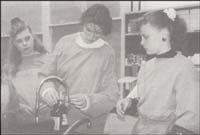
Last May, in Fort St. John, the girls in one workshop prepared and took home a small jar of hand cream, learning about ratios and proportion in the process. Other workshops, have drawn from geology, statistics, engineering, and electronics. Most (though not all) are led by women, and this gives the girls a chance to interact with a woman scientist in a small group, which often leads to discussions that carry over into lunch and snack breaks. Workshops for parents and teachers are held concurrently with the science and math workshops for the girls. These have included discussions of various ways to encourage girls in mathematics, explorations of the roadblocks to full participation of women in the sciences, and reports of successful programs to increase the participation of girls in high school math classes. We have also often included successful panel discussions in the conference. Panelists in mathematics-related careers discuss the place of mathematics in their lives and encourage questions from the audience. From the beginning, the conference attracted numerous enquiries from outside the Vancouver area. In 1989, a limited number of participants from other regions came to Vancouver, and this year we will be able to sponsor up to fifty out-of-town students. However, we believe it is more effective to take the program to the girls in their own communities, because in this way we can include many more girls and make better use of resources and facilities. In 1989 SCWIST received a grant from the Secretary of State of Canada to organize five Women Do Math conferences in smaller centers. |
| Back | Contents | Next |