I really enjoyed my last year, not only because it marked the end of a long term goal but because I took courses that I found very relevant to my interests. Two courses in particular influenced me a great deal: Restoration and Eighteenth-Century British Literature, and Twentieth-Century British Literature. Eighteenth-Century British Literature, taught by Dr. Allison Conway, had an incredible effect on me. In her first year as a professor, Dr. Conway contributed more than just her own knowledge and experience. She conveyed a real love for the material and her enthusiasm was contagious. We had a very full reading list but anything less would not have been enough.
Not until this class experience, for which I had to wait until my fourth year, did I realize how many women writers there were over a hundred years ago. The desire to have our voices heard is not young. What I also had not expected is that the issues these women confront are not far from those faced by women writers today. As I witnessed a tradition of women's writing unfold before my eyes I saw that I wanted to be a part of that tradition and that I could be part of it. A part of any budding freelance writer's career is checking out the competion. An interesting portion of my ground work began in my Twentieth-Century British Literature course with Dr. Patrick Deanne. In this course we discussed works spanning from before World War I to the present. The contemporary works were particularly interesting because few other courses looked at writing that is not published in large anthologies. And while there are more anthologies available which cover a wider range, it remains necessary to go outside these sources for a comprehensive look at contemporary literature. Professor Deane added books to the course including The New Poetry published by Bloodaxe Books, Angela Carter's Nights at the Circus published by Vintage, and The Penguin Book of Modern British Short Stories. Stepping away from the standard forum of literature was refreshing and enlightening. I saw how more women today write poetry or short fiction than long novels. I saw how the issues women writers confront encompass even established literary genres and how important this is in developing one's own literary style. After studying the works of these contemporary writers, I feel I an not alone in my thoughts or in the ways I would like to express them. A door of possibilities has been opened. I leave the classroom behind now, but as I work towards my future goals I will remember what I learned in my university years: that there is no standard way, that I am not alone in my desire to write, and that when I write I speak with my own voice but I take with me the voices of women who came before me. Pamela Simmons, a 1995 graduate of the University of Western Ontario, is pursuing a career as a freelance writer. She would like to dedicate this article to her grandfather William Robert Wright, who passed away only a few months ago. Her grandfather's love for his family and pride in things Canadian are often a great source of inspiration in her writing and in her life.
|
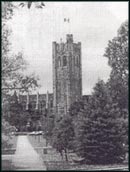 University College,
University of Western Ontario
University College,
University of Western Ontario| Back | Contents | Next |