|
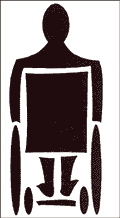
The lines of misconception weave around and through each other, creating a spiraling maze of misinformation and misunderstanding. We somehow have to unravel this maze and work our way through if people with disabilities are ever to be taken seriously as contributing, fully participating members of society with the same needs for educational opportunities and advancement as everyone else. Stages won't be routinely accessible until performers with disabilities routinely appear. Schools and workplaces won't be routinely accessible until people with disabilities begin to play all the possible parts that any person can assume in society. The "Cure" It's not a miracle that people with disabilities are getting up out of their "sick" beds in growing numbers. Nothing has changed about our condition. We don't need to be cured- there is nothing wrong with being different or doing things in different ways. An advertisement for The Spinal Cord Society currently on television makes me crazy every time I see it. Their slogan is "Cure, Not Care" and they have taken the universal wheelchair access symbol and drawn a line through it resembling a no-smoking sign I find this offensive. It portrays disability as a disease needing cure and also plays into all the stereotypes the medical model has produced about disabled people needing to be cared for. The real miracle we need to see is the transformation of attitudes in society. We need to see wheelchairs acknowledged as a legitimate means of mobility; blindness, deafness, and other disabilities all recognized as acceptable, vital ways of experiencing the world. This kind of miracle seems to me much more likely and much more beneficial than searching for cures for individual disabilities. I'm not saying research isn't important; I'm differentiating between disability and disease.
We are just beginning to shed the medical model of disability and demand the transformation of attitudes. Centre for Independent Living and other consumer-fun groups are replacing the service-providing kinds of organizations that have long been staffed by non-disabled people who believe they know what is best for us. While non-disabled people may indeed be able to help and contribute much to improving the lives of people with disabilities, people with disabilities need to be the experts. We need to seek advice - and expertise from each other and find solidarity in shared experience and common understanding. It is essential to establish our credibility as a
minority group in a society where the majority is non-disabled. We must take
ourselves seriously, recognize our worth and fight with everything we've got to
make others see what we have come to see about our role and worth in Canadian
society. Miracles do happen, but let's make sure the miracle we ask for is the
one that will serve all of our communities best. Jane Field is a literacy program worker at St. Christopher House in Toronto. She is also an educator on disability related issues, and a singer/song writer whose first recording of satirical songs about attitudes to disability, called "The Fishing is Free, " was released last year. 1. These two views of disability are adapted from "The Social Semiotics of Disability" by Gary Woodill in Marcia H. Rioux and Michael Bach, eds. Disability Isn't Measles. The Roeher Institute: North York, 1994, pp. 215-217. |
| Back | Contents | Next |