|
In a
traditional marriage,
where
women are
the property
of their
husbands,
men do
not
want their
women
to learn
more than
they know.
|
|
We learned this as women brought out papers for us to help
decipher. We provided the help as they requested, but first asked what they
thought the paper before us was about. In this way, we became aware that they
can read more than they acknowledged.
Our staff talked a lot about what we increasingly noticed as
the invisibility of women's literacy in English. In most cases, when asked,
wives say that their husbands know more English than they do. When couples are
interviewed together, the man agrees that he knows more English. Sometimes
further questioning reveals that the wife can read more, but often her greater
facility with the written word is unacknowledged. This is not meant to imply
that literacy skills in English are good - nor that the literacy of the women
is perceived to be less than it is, and that wives defer to their husbands as
to who is more competent. My guess is that wives not only present their
husbands as more competent, but believe that they are. Most of the women do not
feel very confident in themselves, and talk of feeling ashamed. Several
describe how their husbands "call them down," tell them they are stupid,
illiterate, even whores; at the same time, they oppose their wives taking
classes.
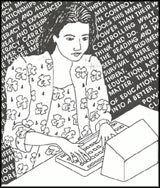
L. Emily Elliot |
|
In a traditional marriage, where women are the property of their
husbands, men do not want their women to learn more than they know. Except for
a few cases where the man is well educated and/or fairly fluent in English,
husbands are opposed to their wives taking classes or learning more than the
rudiments of literacy in English. Once literacy carries with it the symbolic
power of education, it poses a threat to the power (im)balance in the family.
Men need to feel in control; not only does this mean having more power than
their wives, but controlling what they think and do. This is especially so in a
society where the man feels little or no power at work, in the family as the
breadwinner, or in other positions associated with masculinity. This may
explain the large investment in the macho act of drinking. According to the
women we interviewed, masculinity as domination is especially brutal in a
culture where machismo reigns. The words of Maria echo the feelings of many: "I
don't want a macho. I want a man ."
Many of the women live with violence in their daily lives.
Alcoholism, or heavy drink- ing by their husbands, left them feeling desperate.
Modesta breaks down and sobs: "He drinks a lot. He is very much like a man.
Right now, things aren't going very well for us. He loves his children very
much but he treats me badly. Very badly." Several related stories of being
physically beaten; some flee their homes and a couple call the police or turn
to the priest. Rosa related part of her story:
|
It got to the point where he was drinking so much.
He'd come home and try to beat up on all of us. My children were very small. I
used to tell him you can do anything to me - he'd get mad at me and beat me up
- but please don't touch the children. Leave them alone. |
While it is true that not all the women talk of violence, it is
also very true that we asked very little about marital relationships - we did
not even directly ask about the husband's attitude toward their learning. What
is quite amazing is that these stories come out in the course of informal
conversations between women about how English-language practices fit into the
texture of their daily lives. It is the fact that I did not explicitly look for
this information and did not fully appreciate its significance when I heard it,
that makes me aware of the importance of reconceptualizing how we think about
literacy and educational participation where it involves women. |