Such facts are provided in the 1992 text Multicultural Education of Children and Adolescents by Leroy G. Baruth and M. Lee Manning. The table of contents reads: Chapter 1) Our Increasingly Multicultural Society; Chapter 2) Understanding Native-American Children; Chapter 3) Understanding African-American Children; Chapter 4) Understanding Asian-American Children; Chapter 5) Understanding Hispanic-American Children. The notion that one can understand and know the "other" is all within the capabilities of Lady Bountiful, particularly if the "other" is neatly totalized in chapters in a book. Identities of minority groups becomes stable, fixed, and knowable while whiteness is rendered invisible.
The Baruth and Manning text has its Canadian counterpart in the recently published Children of the Canadian Mosaic (Ashworth). The text, which is already on the curriculum for teacher training courses in Ontario, provides chapters describing the history of Native, Métis, Black, Chinese, Jewish, Ukrainian, Doukhobor, and Japanese children as well as street or poor children in Canada. The histories of white, middle-class Anglo-Saxon children in Canada are not named and become the invisible norm, separated from the "mosaic." This kind of depiction insures that the historical relationship between and among dominant and non-dominant children can be easily ignored. It is important that teachers acquaint themselves with their students and their families. What we are suggesting is that the imperative to "know" minority students and the language and image in which it is couched operates to keep invisible white privilege and the hegemony of dominant culture. This serves only to reinforce the marginality of non-dominant groups. Lady Bountiful, in her more current day representation, may not overtly contain any colonizing aim or intent but the effect is nonetheless similar.
It is predictable that for Lady Bountiful, and more generally, for white academics operating within the multicultural frame, a crisis point occurs when people of non-dominant cultures will not surrender their knowledge, their cultural practices, or their artifacts. Without this knowledge the role of Lady Bountiful cannot be enacted. It becomes imperative that the margin speak to the centre. As captured in the book When Cultures Clash: Case Studies in Multiculturalism (1984), there can be an almost aggressive insistence that this happen. After indicating the need to find community support for implementing multiculturalism, the author writes: "There are many other resources yet untapped. Not the least of these is the membership of minorities themselves (many of whom are recent immigrants), whose task is to adjust to the Canadian way of life while sharing aspects of their own identity. In the same sense that newcomers have an obligation to their new homeland they should be expected to share freely of their background as a means of enriching this land culturally" (Friesen 16). Nobel Peace Prize winner Rigoberta Menchu depicts the determination to keep her identity and culture from academics, who would have it otherwise. She writes at the end of her book (I Rigoberta Menchu): "Of course I'd need a lot of time to tell you all about my people, but it's not easy to understand just like that. And I think I've given some idea of that in my account. Nevertheless, I'm still keeping my Indian identity a secret. I'm still keeping secret what I think no one should know. Not even anthropologists or intellectuals, no matter how many books they have, can find out all our secrets" (247). |
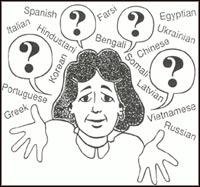 Teaching to
Diversity, by Mary Myers, pg.20
Teaching to
Diversity, by Mary Myers, pg.20| Back | Contents | Next |