|
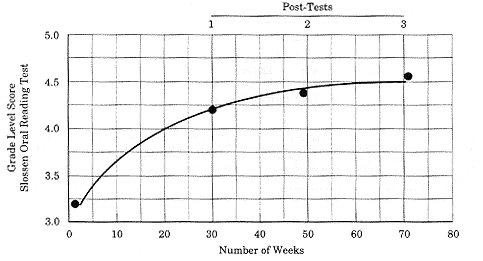
LONGITUDINAL STUDIES Finding systematically gathered and reported data on pre- and post-test scores in adult literacy programs is rare enough, but finding data in which adult literacy students have been repeatedly post-tested to determine their growth in literacy ability over time is extremely rare. Figures 99 and 100 present two rare sets of data from programs in which learners were repeatedly assessed over time. Figure 99 reports data for 765 learners in minois who were assessed as part of the minois Literacy Project (see page 146 of this Compendium for additional information about this project). The learners were from 23 different programs that used Literacy Volunteers of America, Laubach Literacy, or "eclectic" approaches to literacy instruction. The adult learners were tested repeatedly using the same form of the Slosson Oral Reading Test. So some practice effects are possible. As Figure 99 shows, most improvement was made between the pre-test and the first post-test. Overall gain from the pre-test to the last post-test was about 1.4 "years." Figure 100 presents longitudinal data from the Literacy Assistance Center in New York city for adult literacy learners who were enrolled for either two or three years (see page 147 of this Compendium for additional information about this project). Learners were assessed using different forms of the Tests of Adult Basic Education (TABE). The figure shows that most improvement occurred between the pre-test and the first post-test, a finding similar to that of the longitudinal data for Illinois (Figure 99). The most improvement was made by those students who pretested at the 1.5 reading grade level. They gained about 2.0 "years." Both the Illinois and New York city data suggest that, following the first gain from the pre-test to post-test 1, subsequent improvement occurs at a lower rate. Clearly, assuming everything else stays the same, for students in these studies who score at the lower levels on the pre-tests (below the 4th grade), several years of study would be necessary for them to achieve at the 9th grade level or above.
 |
|||||||