|
C. Courageous Spirits
|
* * * * * * * * * * * * * * * *
If you can,
buy the book, Courageous Spirits, so you can learn about Trickster from
First Nations people. There is also an excellent teacher's guide. You might
invite a local elder in to tell you some local Trickster stories. Contact the
office of a First Nation or a Native Friendship Centre in your area to find
someone who would be willing to come in. Perhaps one of the students knows
someone who would be an interesting guest story teller.
* * * * * * * * * * * * ** * * *
Later in this
chapter there is a list of many other easy-to-read books that are first person
accounts of women's lives. (See Resources on page 116).
A story from any of these books could be used instead of or in addition to
"Kirsten."
|
|
Courageous Spirits is a collection of stories written by
aboriginal children all across Canada, about their heroes. The book also has a
story about Trickster who ties all the stories together. Trickster is a
character who is part of many aboriginal cultures; the elders have called him
or her many things, including Raven, Coyote, Wesakejac, Flint, Nanabozo, and
Glooscap. He/She/It helps teach cultural values and history.
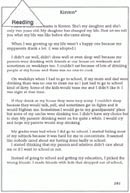
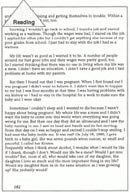
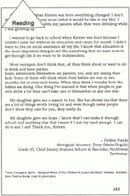
2. Reading: "Kirsten"
* Start with a prediction exercise. Read the first paragraph and
discuss what students think is going to happen in this story. Make a few notes
so you can compare your predictions with the story after you read it.
* Read the story (pages 118) You might
stop after paragraph 12 to check the facts. At this point, people in the class
might want to tell stories that are like Debbie's, either their own stories or
those of someone they know.
* Compare your predictions with what really happened.
* Some questions to consider:
- What were the barriers Debbie had to overcome in life?
- She doesn't say much, but imagine some of the situations
that would have occurred while she was changing her life-scenes with her
parents, her friends, the doctors and nurses, her welfare worker, landlords, or
the school.
* Other activities:
|
* * * * * * * * * * * * * * * *
I find
Readers' Theatre a very useful technique when working with literacy students.
It is really theatre of the voice; the script is read by the actors, and there
is no moving around stage, and little or nothing in the way of props. The
technique is to look down at the script, silently read a sentence, look up and
"perform" it, then look down, read the next sentence silently, look up and
"perform" it. Emphasis is not on reproducing the text exactly, but rather on
giving the line with expression. During rehearsal, speeches can be performed
around the circle, without assigning a particular character to a particular
actor.
|
|
- As a group, write a short drama of the story and have people
perform it. This can be done with full acting and props or as Readers' Theatre.
- Do a "chair talk" of one or more of these scenes. Put the
names of each character on a chair at the front of the room. Whoever sits in
the chair speaks ad lib for that person.
- Make a collage with two sides. One side shows Debbie's life
before Kirsten and the other after. The collage could include such things as
drawings, cut-out pictures, words, poems, small objects, stars, stickers and
glitter.
3. Discussion and writing
* Some questions to consider:
- What qualities enabled Debbie to turn her life around?
- Which kind(s) of role model is Debbie? That is, which
sheet(s) would she fit on?
- How is Debbie like you? Do you have some of her
characteristics? Have you ever been in a similar situation? What did you do?
Write or tell about it.
- If this story reminds you of anyone you know, tell or write
that person's story.
- Write a letter to Debbi Franki. Debbi was in Grade 10 in
1993. Someone in her school or her community will be able to find her to pass
on your letters. You might put "Please Forward" on the envelope. Use your local
library or government office for help with the exact address.
|