|
1. Introduction
* Bring in a can of salmon, and place it in full view of the
group. Ask learners to tell you anything and everything they can think of about
that can. Encourage any answers - "It's salmon," "It's round," "It's
expensive," "It's on sale this week at Safeway."
|
* * * * * * * * * * * * * * * *
Depending on
learners' interest in salmon, per se, they could research packing procedures -
how has technology helped or hindered the process? What work is involved? Who
does that work?
* * * * * * * * * * * * * * * *
Other areas of
discussion that could arise, given learners' interest and experience, include
physical labour, seasonal work, field work, fisheries, agriculture, even shop,
factory or post office work at Christmas rush.
* * * * * * * * * * * * * * * *
Some students
may have stories to share about canning, field work or even gardening they have
done as a part of their families' means of producing and preserving food.
Encourage learners to share these stories and perhaps to focus on different
jobs that were allocated to boys and girls, men and women.
|
|
* When learners feel that they have no more to say about it (and
if they haven't already begun to talk about the following), ask them:
- Where did the tin of salmon come from?
- What's inside? How did it get there?
- Who catches the fish?
- What happens to the fish after it's caught?
- Who actually cans salmon? What's the process?
* In terms of the larger issues of factory work, repetitive,
uncomfortable work, and working conditions, ask learners to share their
understanding and perhaps experience of food processing or other kinds of
work.
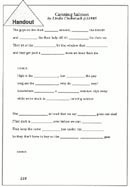
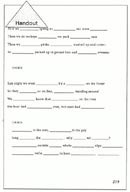
* After the discussion, play the song once, give learners the
cloze sheet (page136) and ask them to fill in the missing
words, playing the song as many times as is needed or until learners are ready
to assist one another in completing the cloze.
|
* * * * * * * * * * * * * * * *
In the case of
both songs, an alternative approach is simply to listen to the songs with
learners and to then respond to their responses to the songs - by eliciting
questions, pursuing some of the exercises suggested above, or by encouraging
learners to design their own questions and areas of study based on their
interest in the songs, and perhaps in other areas covered in this or other
chapters.
* * * * * * * * * * * * * * * * *
The book A
Newfoundland Spell contains stories written by adult learners in ABE
programs in Newfoundland, many of which directly address issues of the
fisheries and their closures.
(See Resources on page
130)
|
|
* Once everyone has completed the sheet, take the time to go
over any needed vocabulary work.
2. Writing
* Find photos in the library of women canning salmon.
* Ask learners to talk about these pictures, perhaps to read the
texts, as time and interest allow.
* Ask learners to choose one of the women in one of the photos,
and write from her point of view:
- Describe a day at work to a task force investigating working
conditions in the industry.
- Write a letter to a friend far away.
- Write a diary entry.
F. Barriers
1. Guided discussion
* Ask learners to discuss the following myths about women and
work:
- Women aren't reliable workers because they often have to
look after sick children.
- Women are too emotional to work in high pressure jobs like
law enforcement and fire fighting.
- Women don't like to get dirty.
- Women aren't strong enough to work on construction sites.
- Women spend too much time talking about feelings and they
gossip at work.
- Women are too emotional to be good at business.
* Ask learners to discuss the truthfulness (if any) of these
statements and also ask if they can think of other negative stereotypes about
women and work.
* Ask the group to think about how can they respond to these
negative statements.
* What real and perceived barriers exist for the
women in your group as they contemplate employment?
For example:
| real barriers |
perceived barriers |
possible solutions |
| |
|
|
| unequal responsibility |
women are irresponsible |
good childcare; |
| for children |
about work; they'll miss |
some flexibility at the |
|
too much work if their |
work site |
|
kids are sick |
|
| |
|
|
| need for certification, |
it's too difficult to learn |
research into training |
| training |
a trade |
requirements |
| |
|
|
| cost of tuition for |
training's too expensive |
bursaries, sponsorship, |
| training |
|
financial aid |
| |
|
|
| need for reliable |
it's too far to travel |
carpools, |
| transportation |
|
public transportation |
|
* Once women have thoroughly discussed the barriers they
envision, they may be prepared to return to the list of occupations they
brainstormed at the beginning of the chapter and to begin learning more about
particular jobs. |