|
G. Facts and Numbers
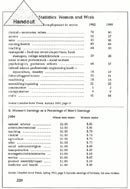
1. Graphing: The work women do * Give learners "Statistics: Women and Work" (page 137) and look at Part A. * Discuss what jobs a person might do in each category.
* Choose five or six of these professions and make a bar graph showing how women's participation has changed.
* Make a bar graph showing all the professions for 1989. Put them in order from smallest to largest. * Make a bar graph showing the four sectors with most participation by women and the four sectors with the lowest participation by women. 2. Graphing: Men's and women's earnings * Introduce the idea of proportion expressed as "For every (number) in this category, (number) are in the other category." Use the example of a pair of students who have two and four children, respectively. For every one child A has, B has two. Set up some comparisons of pens or books, for example, for every three pens A has, B has two. * Show the group the figures that compare earnings for men and
women in the sales sector. (page 137, Part B) H. Choosing an Occupation This section may be relevant only to learners who are actually seeking work. 1. Guided discussion * Ask learners to talk about jobs they've done and to think
about ways they could do that work for pay and/or to consider other different
jobs.
* Learners can research these occupations by listing the questions they have about them. They may choose to narrow the focus - omitting some of the occupations listed and perhaps adding others. They may wish to work in pairs or small groups to research occupations of particular interest to them. Government publications (pamphlets, especially) might be helpful. As well, the group may wish to invite speakers who work in fields of interest to come to talk about them. Obviously, it will be helpful to invite women who are working in those fields to come to speak to the group. If a woman is not available, after a presentation by a man, it would be interesting to ask the group to discuss how or if a woman might have spoken differently about the job that the speaker described. |
| Back | Contents | Next |