|
2. Interest inventory
Once the group has generated a list of occupations and the
requisite skills and abilities attached to each, they can begin to think about
the ways in which their own skills and interests mayor may not match a
particular occupation. While the focus of this chapter is to encourage women to
consider occupations in the trades, it seems important not to discourage women
from exploring any occupation which is of interest to them.
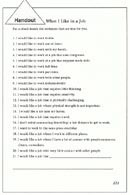
* Give learners the interest inventory, "What
I Like in a Job".
* Learners can work alone or in small groups to think about
these statements. The aim here is to ask learners to focus on various aspects
of daily work in very concrete ways.
* Learners can make a large grid on newsprint to gauge their own
and others' responses to the statements. They can interview one another, or
fill in names of people who respond positively to the statements on the sheet.
| Statement |
Names |
| |
|
| 1. |
would like to work |
Julia, Christine, Paula |
| |
inside |
Anna, |
| |
|
|
| 2. |
would like to work out- |
Christine, Anna, Jade, |
|
of-doors |
Sandy, Kitty, Hong |
| |
|
|
| 3. |
would like to work with |
Jade, Hong, Patty, Rosa, |
| |
my hands |
Ho Sing |
|
|
* * * * * * * * * * * * * * * * * * * * *
Another way of approaching this entire topic may be to ask women in the
group about work they know of in their immediate community. Do they know women
working in particular jobs? What do they know about those jobs?
* * * * * * * * * * * * * * * * * * * * *
The
point here is not to discourage women from exploring a particular field of
work, but rather to help them remember all the steps necessary for learning
about and pursuing opportunities in that field. At the same time, these
discussions call for walking the fine line between an optimistic planning for
work they would like to do, and the practical realities of the job market.
|
|
* Once everyone has discussed the questions, ask learners to
write a profile of their own interests and plans for finding work and getting
training as necessary.
* Once all the profiles are complete, invite learners to discuss
their plans with one another. Some questions to consider:
- Is the plan feasible?
- Does it include finding information about the job?
- Does it include finding out about appropriate training
courses?
- Does it include finding out about the availability of work
in their areas of interest?
Resources
(See the Bibliography for complete
listings)
Braid, Kate. Covering Rough Ground
| Canadian Social Trends |
|
This is a very useful periodical. It is full of
interesting statistics on life in Canada, articles that compare the same thing
over time, or differences and similarities between provinces, age groups, sexes
and so on. It is easier to use than many of the reports put out by Statistics
Canada, since it provides some interpretation of them, and often features
graphs and charts. The articles, of course, are difficult to read, but the
charts and graphs make interesting reading for literacy and EAL students.
|
English, Betty Lou, Women at Their Work
A
Newfoundland Spell: Contributions by Students in Basic Education
Programs
Stewart, Donna, Jobstories: I Like the Work; I Like the
Money
Wallerstein, Nina. Language and Culture in Conflict:
Problem-posing in the ESL Classroom
Wayman, Tom, ed. Going For
Coffee, Poetry on the Job
| Films |
|
9 to 5
Laila
Moving Mountains
Norma Rae
Pretend You're Wearing a Barrel
She's a Railroader
Trade
Secrets: Blue Collar Women Speak Out
Working Girl |
Audio Tape
Fraser Union
with the Industrial Writers' Union. Split/Shift: Songs and Poems of the
Workplace
|