|
8. Case study 1: Pressure
 These two case
studies (E-8 and E-9) invite learners to distinguish between pressure and
force. The discussion about the case studies may lead women to disclose
violence in their lives. These two case
studies (E-8 and E-9) invite learners to distinguish between pressure and
force. The discussion about the case studies may lead women to disclose
violence in their lives.
* Present this case study: When Matthew and Linda had gone out
for awhile, Matt said, (1) "We don't need condoms any more. (2) "Trust me." (3)
"I'm clean." (4) "If you don't trust me it means I can't trust you." He was
angry as he said the last sentence. Linda is afraid that Matt will leave her if
she doesn't do what he wants. She doesn't want to be alone.
* Some questions to consider:
- How are each of Matt's four statements pressure?
- Does he makes it hard for Linda to disagree? How?
- Does he try to get Linda to change or ignore her feelings?
How?
- Does he let Linda think he might leave her? How?
- If Linda gives in to pressure, is she responsible if she
gets HIV or another STD?
- What choices can Linda make?
- Where could Linda get support to choose safer sex? (Safer
sex/STD counsellor.)
- If Linda lived here, where could she find a safer sex
counselor?
9. Case study 2: Force
* Present this case study: Carla learned that Bob had unsafe sex
before, so she asked Bob to have an HIV test. "Are you saying I have AIDS?
You're crazy! I'm healthy! Don't ever talk about this again," he said, raising
his fist. "Or you'll be sorry."
* Some questions to consider:
- Would it be safe for Carla to talk about condoms?
- If it isn't safe to be assertive, should women be assertive?
(No.) What can a woman do instead?
- What is the difference between pressure and force? What is
force?
- Might Carla decide that worrying about HIV is not her main
problem now? Why or why not?
- Is Carla responsible if she or her baby gets HIV or other
diseases? (No.) Why is it not her fault?
- How could a counselor for safer sex help Carla?
- Where else could Carla go for help?
- Is forced sex unsafe sex?
10. Practise assertive responses
to pressure
|
* * * * * * * * * * * * * * * *
How do you
decide if it is a pressure statement? You might ask, "Does it make the woman
feel uncomfortable, or that her needs are not important, or that there is
something wrong with her request?" The more statements there are on the list,
the easier it is to identity pressure statements.
* * * * * * * * * * * * * * * *
See also "Women and AIDS: Choices for Women in the Age of AIDS," page 6.
|
|
* List things a man might say when he does not want to use a
condom.
* Decide which ones are pressure statements, and put a star beside
them.
* Examples of pressure statements:
- Sex isn't unsafe because I love you.
- If you really like me, you'd...
- We can't afford condoms.
- You're selfish.
- I want to go natural.
- I'll put it on soon; don't worry.
* Review the parts of an assertive response (page 163).
* Reply to one pressure statement at a time,
giving an assertive response. For example:
- You don't like me. (I do like you; I want to protect us
both.)
- I had a test. (Were you tested for all STDs? Let's have
safer sex until we see a counselor.)
* Discuss what makes it hard for a woman to respond assertively
to pressure.
* You can role play pressure statements and responses in the
large group or in partner pairs.
11. Group exercise: setting
limits
* Learners negotiate their boundaries with each other. Explain
the exercise and ask one partner pair to begin. One person stands still and the
other walks towards her, beginning 20 feet away if possible. The rest of the
group observes. (This can help the pair feel safe - it is public).
- The walker walks slowly towards the standing person.
- The stander must tell the walker when to stop, or back up,
and how close she wants the walker to be. If she is silent, the walker
continues walking.
- At any time the walker may stop, and say, "This is where I
want to stop." She may stand there a while, choose to go closer if invited, or
back up.
- The distance between the two people is always established by
the person who wants to be furthest away.
- After the partners have negotiated a distance, the pair
changes roles.
|
* * * * * * * * * * * * * * * *
I learned this
exercise from a college leadership-training course with Ron Witort.
|
|
* When all have participated who want to, ask participants and
observers to share what they wish to and discuss the experience. Some questions
to consider:
- What did you find easy or hard about the exercise?
- Ask questions to help learners make links between this and
setting other boundaries.
12. Reading: "What Do You
Think?"
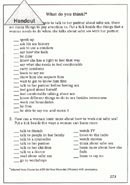
* Ask learners to complete "What do you
think?" (page 164), which identifies skills and behaviors needed for safer
sex choices and asks where women can practise these skills.
* Invite learners to share and discuss their answers. |