|
CHART 5
Adult Education in Canada / Providers by Sex
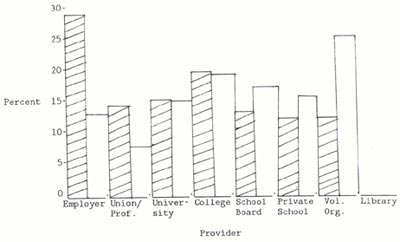
Male _ _ _
Female ______
Source: Statistics Canada 1984, in CAAE, Analysis of Statistics
Canada Adult Education Survey, January 1984.
For those women who are unemployed, or are employed in
low-quality jobs, the situation is disturbing. Few employers can afford to
train part-time or minimum wage employees. Statistics Canada's Adult Education
survey found that less than 14% of women's training is employer-supported,
while 35% of men's training is paid for by employers (39). This result is
probably only in small part due to direct discrimination. For the most part, it
is reflective of the kinds of jobs women tend to hold. And of course workplace-
based training is not helpful to those who have no workplace -- the unemployed.
There are large numbers of unemployed and underemployed or dead- ended
women in every region of Canada. The problem is not a small one. For these
women, outside of locally-based Continuing Education courses and a decreasing
number of community college courses, the major source of job- related training
is federally-sponsored programs run under Canadian Jobs Strategy. Job Re-Entry
is designed specifically for women returning to work after at least 3 years out
of the labour market. Unfortunately, this excludes those who cannot afford to
stay out of the labour market or who as recent immigrants are legally required
to work. Job Development also offers learning opportunities for women and men
who have been unemployed for at least 30 weeks out of the past 52.
Our interviews confirmed that, across the country there are
privately. sponsored Re-Entry and Job Development programs which are respected
and which appear to be doing a good job. However, there are also some which
have been exploitative or simply abysmal in quality. Current funding criteria
do not appear to provide the basis for discrimination between those sponsors
who are able to offer a high quality program and those who are not despite or
maybe because of a tortuous proposal development process. Several interviews
expressed a concern that patronage is further blurring an already confused
situation. One in-depth study has pointed out several ways in which standard
program structures actually militate against the provision of high quality
programs (40). Interviews everywhere identified a need for effective screening
and monitoring of all private training organizations and especially those to
whom the awarding of a federal grant has given an apparent legitimacy.
|