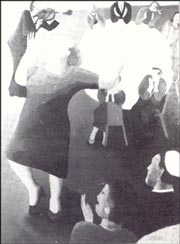
That and coming to the realization that I do have the right to be an artist. I remember the moment I was painting in the large room that served as the painters' studio when the thought occurred to me that because I was a woman I couldn't be an artist. It was an important moment for me and one that many women artists share. This realization was the beginning of changing my consciousness. A lot of my learning since leaving art school has come through intensely studying other artists' work. By doing this I've learned how to paint like they do, and I guess that's all come together and amalgamated into my own work. I've gone through periods when my work looks like John Paul Lamieux's or Chagall's or that of other artists I have admired. The most intensive study for me was investigating colour. I was not taught colour at art school, but I felt that I had an innate colour sense, which is what I think everyone believes until they learn better. Once I went to a theatrical production and realized there was something happening with the -lights and colour that I didn't understand. A system was at work. Very soon after that, I came across a book called The Art of Colour by Johannes Itten. It was a reference book, and the librarian kindly allowed me to take it out for just three days. That limited time turned out to be a very good thing because I forced myself to really study the book and write down the important points. Over the next year, I set a schedule for myself. I tried out all of the combinations on the colour wheel that are considered harmonious. I set limits on subject matter in order to do this, using the same or similar black and white photographs in all the studies. I wasn't concerned about content but wanted to learn to use colour in new and more beautiful ways. It worked! It was the most intensive study I had ever done, and it taught me that I could learn something from books on my own. I also learned a great deal from that experience about the emotional values of colour and most importantly, how to analyze. When I look at nature or other artists' work now, I know what colours I am seeing and I can understand by naming them aloud what particular combinations on the colour wheel they represent. Analyzing colour, in this way, led me to be able to analyze other aspects of art. What I have come to realize since beginning this article is that I have indeed learned and grown in other ways through my work. One of them has been learning about myself. Mostly I've done that by examining my past. The painting I did of the Chicago convention titled August, 1968 comes out of a traumatic experience in my life which became my reason for leaving the United States. My then husband and I and some other friends had gone to Lincoln park in Chicago to be part of a huge group of people protesting the nomination of Hubert Humphrey. He was a candidate who had not taken a strong enough stand against our participation in Vietnam. This was the first night and the Chicago police went on a rampage. People were tear-gassed and beaten just for congregating in the park and the culmination of the evening was that a reporter was beaten on the hood of our car. I was terrified and went down to the floor. Afterwards we took the bleeding man to a nearby hospital and later were called on to testify against the police department. It was in 1984 that I decided to paint that experience. I had just found photographs of the incident that I had not known existed or that I had with me. I totally immersed myself in what had happened; it was a very emotional experience. I cried a great deal which helped me to get through a sort of catharsis. But painting the experience diffused the feelings so that I could understand them and put them into some sort of context in my life. |
| Back | Contents | Next |