|
Ninety-nine percent of the native language instructors at this time were women who were fluent speakers of the language they were teaching. They were mostly middle aged or older, with little or no formal education, but with a wealth of cultural knowledge accumulated in traditional Athapaskan life experiences. Many of them headed large extended families and many had young dependent relatives who relied on them for support. All of them were valuable cultural resource people in their communities, and they often had other jobs and responsibilities. Many of them had been with the Native Language Programs in their schools from the beginning, and had acquired years of classroom experience.
Although the Yukon Government had a policy of support for the Native Language Programs, the instructors for these programs were hired as casual temporary workers and paid by the hour, with no benefits, no pension, no pay increments, and no job security. Ironically, they were invariably the senior staff members in their schools, while the "turn over" for teaching staff and administrators in rural schools averaged every two years. The native language instructor, an integral part of her community, remained in her position year after year. Many of these instructors, when they think of their early teaching days, do not remember being too concerned with the lack of pay and benefits. They were concerned with learning how to do those jobs. They were satisfied with the development of curriculum, the training courses offered in Whitehorse, and the regular development of new ideas and materials for their classrooms because their main concern was for the preservation of their language. Although the Y.N.L.P. encouraged the instructors to join the Yukon Teacher's Association, or form an association of their own, the instructors as a group chose not to do so. But when some of the Elders who had founded the earliest programs began to retire with no accrued benefits, no pension and no official recognition of the contribution they had made, the instructors asked for information about associate membership in the Yukon Teacher's Association. They received a series of delayed, ambiguous responses. In 1983, the Yukon Native Language Project had become a permanent institution-the Yukon Native Language Centre-and it had a small staff of trained "master language teachers" and a three-year Certificate Program certified by Yukon College. All Yukon native language instructors were required to enroll in this three year program. The instructors received credit for their classroom work in a practicum component of the course. Like other kinds of on-the-job training, this had the advantage of providing skill development without disrupting the salary and family life of the employees. 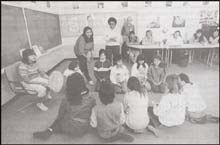 N.L.I. Jane Montgomery and Polly Fraser demonstrate a language activity with their Southern Tutchone students while Native Language Instructor trainees observe |
| Back | Contents | Next |