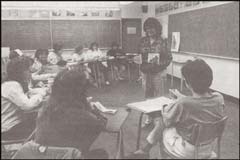
 N.L.I. Margaret Workman conducts a vocabulary drill with her Athapaskan language II class at F.H. Collins High School (1989). The Certificate program was one of the few programs in Canada devoted exclusively to the training of skills of second-language instruction. By June 1989, over thirty native language instructors had graduated from the program. Part of the Certificate Program's success can be attributed to its unique approach to training people without removing them from their families and communities for long periods of time. And part of the success of the program comes from its unique approach to instruction. Y.N.L.C. staff employ the traditional Athapaskan method of instruction: demonstration and observation followed by practice. A typical training session includes a lot of action, and very little of the lecturing and note-taking which characterize a non-native approach to instruction. These unique features have attracted native language instructors from all areas of the north-Alaska, N.W.T., and northern B.C.-and has sparked interest from other many places in Canada, the U.S. and most recently, the U.S.S.R. These regular training periods did more than provide the instructors with skills. They provided the opportunity to exchange thoughts and ideas with other instructors and before long, the group had developed a professional identity. They discussed common professional goals and how to achieve them. They discussed common problems and how to solve them. They relied on their professional peers for moral support and encouragement in their work, and their initial concern for the survival of their languages grew into a commitment to the maintenance and improvement of their language programs. Initially, many of the concerns of the native language instructors were resolved through the support system provided by the Y.N.L.C. But the issues surrounding the growth and development of Native Language Programs in the communities quickly became more complex and often it was the instructor herself who was called upon to provide information and leadership on issues affecting the programs. The professional duties of the native language instructor had extended beyond the school and into the community and sometimes, the issues brought the instructor into the political and economic arenas of the Territory. |
| Back | Contents | Next |