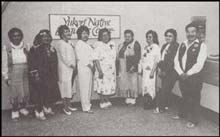
Professional pride and confidence in their knowledge and abilities grew naturally with the development of their teaching skills and the extension of their responsibilities. And with that growth of professional pride, the instructors became increasingly impatient with the lack of response to their requests for a pay scale that would acknowledge their training and experience, and for appropriate benefits, pensions and job security. The Yukon Government, whose policy of support for the language programs helped to accomplish so much, has been very slow to translate this policy into a salary grid that values the native language instructors for their training and experience. A proposal for such a grid has been on the table for longer than three years and still has not been implemented. The Council for Yukon Indians, whose political lobby has helped to achieve one of the most credible training programs for native language instructors in Canada, now seems intent on preventing the instructors from achieving permanent status as Yukon Government employees so they can receive benefits and a pension plan. While a few chiefs support the instructors' requests, other Chiefs fear that such benefits for the instructors would somehow erode their control over the programs. In 1989, after repeated attempts by the Y.N.L.C. to get action on these issues, and after repeated requests for help from the Yukon Teachers' Association and the Public Service Alliance had failed, the Yukon native language instructors realized that they must speak with their own voice. They formed the Yukon Native Language Teachers' Association for the purpose of achieving a salary pay scale, benefits, pension plan and job security. In the meantime, the training program is attracting young women and men-most of them high school graduate and genuinely interested in helping to preserve the link between native language and culture. Young people who are not fluent in the language can team up with an older fluent speaker in the classroom, learning the language while they learn to teach. The interest of these young people in the program will help to ensure the future of the programs and the survival of the language. Pair pay, benefits, pension and job security are important incentives for further encouraging young people to choose native language instruction as a career. Although the development of a professional identity among native language instructors has taken some time to develop, their Association was born out of necessity and has been shaped by its purpose. And because its members are the same women who demonstrated their tenacity and determination by staying with the programs through the difficult developmental years, it is certain that they will accomplish their purpose. C.J. Pettigrew has worked with the Yukon Native Language Centre for 10 years, developing the Yukon Native Language Instructors Certificate Program. She and her husband are partners in an outfitting business and she is a freelance fiction writer. |
| Back | Contents | Next |