Creating Opportunities for Reflection and
Support
What are the common threads that surface from these
experiences? How do I make this exercise more than a cleansing process,
something that can be used to increase our understanding of adult education and
ultimately to improve our practice?
My suggestions for addressing the deficiencies in adult
education focus on the intersecting spheres of the workplace, the community,
and the academy, I present them with the intention that some tangible changes,
however small or seemingly insignificant, can be made to recognize the work of
adult educators and to respond more effectively to the need for emotional and
spiritual support.
The Workplace
|
Because
there is such
a
backlash
those of us
working in
the area are
particularly
vulnerable,
especially
those of
us visibly
connected
to
a feminist
philosophy. |
|
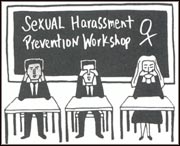
- Education is only a part of the solution for addressing
the issue of sexual harassment in the workplace. For educators and
administrators of educational programs, it is critical that a more realistic
picture be presented of both the possibilities as well as the limitations
associated with education as a tool for social change. There should be
diversity in the educational options, some of which would be more suited to
high risk work environments (such as the trades or male-dominated workplaces or
where there has been a history of complaints) and others to low risk
environments. As well, educational initiatives should be tailored towards
specific segments of the organization. For example, education directed at
management or supervisory personnel should not only focus on general awareness
and prevention but on the specific responsibilities of senior personnel to
demonstrate commitment, handle complaints, and act pro-actively against sexual
harassment.
- It is critical that educators be provided opportunities
within the workplace for physical, psychological, and spiritual rejuvenation.
The majority of adult educators with whom I have contact are creative in
how they nurture themselves. But this takes place outside of the workplace,
which negates the problem as a workplace issue. When working in an area
particularly susceptible to backlash, conscious efforts must be made to
systematically provide support for educators within the workplace, and also to
celebrate our accomplishments.
- Educators should be included in other initiatives related
to the issue they are addressing. Adult educators are most effective when
education is integrated into a comprehensive strategy and information is
provided which allows them to be knowledgeable about all aspects of the issue.
For example, educators could be more closely involved in deciding whether
training should be mandatory or optional, developing effective educational
programs to meet the needs of supervisor / managers or high-risk work
environments, and incorporating the unique needs and perspectives of victims
into the development of educational programs.
|